
1. What E1422 is, in plain words
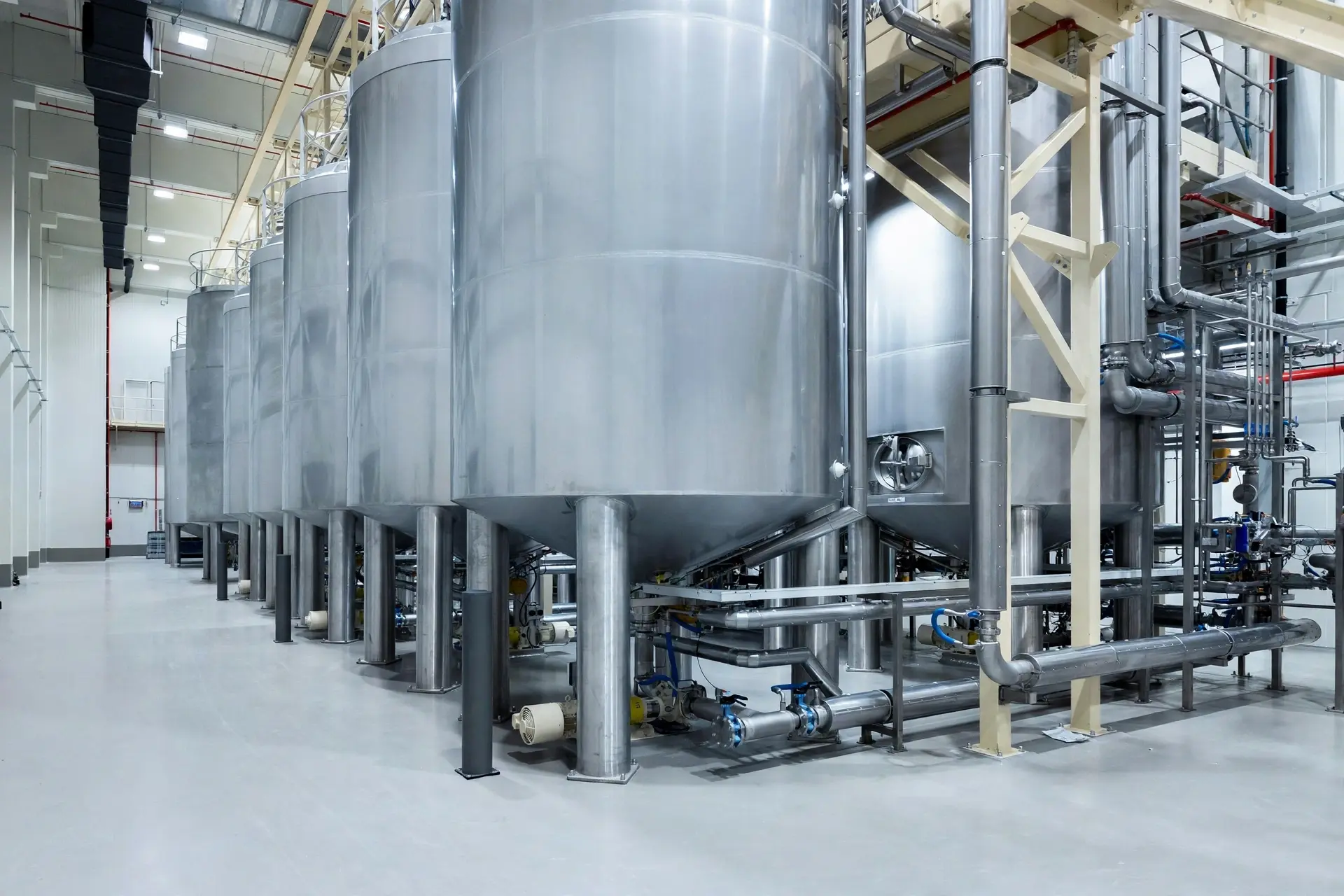
Start with plain starch — from corn (including waxy corn), tapioca, potato or wheat. Plain starch has a weak point: after boiling, pumping, acid or freezing, it breaks down or turns grainy. Food factories need better. So they change the starch in two ways. That is why E1422 is called a dual-modified starch.
Change one — cross-linking. The starch slurry is treated with a small amount of adipic anhydride. It builds tiny “bridges” between the starch chains, like rungs on a ladder. Those bridges keep the granules whole under high heat (up to 120 °C), strong mixing and acid.
Change two — acetylation. Acetic anhydride adds acetyl groups to the starch chains. These groups stop the cooked starch from re-joining, and turning to gel, as it cools and sits in storage. The result: no weeping (the watery layer called syneresis), no grainy feel, and a clear, short, smooth paste.
Quick facts: E number E1422 in Europe, INS 1422 in the Codex system, CAS number 63798-35-6. Makers treat an aqueous slurry of native starch with a mix of adipic anhydride and acetic anhydride under mildly alkaline conditions, then wash, dewater and dry it. On labels it works as a thickener, stabilizer and bulking agent.
2. Market size: the honest numbers
Here is the part most market articles skip: there is no official, audited size for the E1422 market. No government counts it. Published estimates differ a lot: estimates released around 2025 put the global market anywhere from US$160 million to US$6.1 billion — a gap of about 38 times. They cannot all be right, and the scope and method behind most of them are not open to check. After compiling and reviewing these estimates, the Tianjiang team finds the cluster far more useful than any single number.
What can be said with confidence: several estimates cluster between about US$380 million and US$530 million, with growth clustered at 4–6% a year. According to a market review compiled by the Tianjiang team, the most sound single estimate is US$416.7 million in 2026, rising to US$582.4 million by 2033, a CAGR of 4.9%. Its math checks out and it sits inside the cluster. Where this report uses it below, treat it as an estimate — not an official count.
| Estimate | Scope | Market size | Forecast |
|---|---|---|---|
| Estimate 1 (Feb 2026) | Global, all grades and sources | US$416.7M (2026) | US$582.4M by 2033 · CAGR 4.9% |
| Estimate 2 (updated Apr 2026) | Global, food + pharma + cosmetics + textiles | US$382.6M (2024) | US$589.7M by 2035 · CAGR 4.01% |
| Estimate 3 (2026) | Food grade only | US$489M (2025) | US$730M by 2032 · CAGR 6.0% |
| Estimate 4 (2026) | Food grade only | US$530M (2026) | US$890M by 2035 · CAGR 5.8% |
Check the scope before you compare: a “food grade only” figure can be bigger than another report’s “all grades” figure, which shows how soft these numbers are. One widely shared estimate claims US$6.1 billion in 2025 with 4.8% growth — but its own start and end points work out to about 8.3%, so it does not add up. We do not use numbers like that.
The anchor you can trust: the wider modified starch market
E1422 is a small, premium slice of a big market. Two estimates that track all modified starch differ in level (different scope and method — never mix them in one sentence) but agree on the growth rate:
| Estimate | 2025 size | Forecast | CAGR |
|---|---|---|---|
| Estimate A (modified starch market 2025–2030) | US$14.92B | US$17.30B by 2030 | 3.0% |
| Estimate B (updated Jan 2026) | US$16.65B | US$19.90B by 2031 | 3.02% |
The useful detail inside these estimates: Asia-Pacific holds 56.9% of the modified starch market (2025); corn is the lead raw material at 70.84% (2025); and food and drink makes up 55.24% of demand (2025). The Tianjiang team’s compiled review also notes one E1422-only figure — North America led E1422 itself with a 38.9% share in 2025 — but note that this is about E1422 alone, not the big market.
The bottom line on size
E1422 is a niche market of roughly US$500 million a year, inside a US$15–17 billion modified starch market growing at about 3% a year. E1422 itself grows a little faster — 4–6% in the Tianjiang team’s compiled review — because its end markets (frozen foods, sauces, dairy desserts) grow faster than starch as a whole.
3. Where E1422 is used
Every use below comes from real product sheets for grades on sale now — not guesswork. One honest gap: no reliable data breaks E1422 sales down by use. Claims like “soups and sauces are 35–40% of demand” have no method behind them, and we do not repeat them as fact. The one solid share is for the big market: food and drink is 55.24% of all modified starch demand (2025).
Sauces, soups and gravies
The core use. Roquette’s CLEARAM® CH 20 20 and CH 40 20 (waxy corn E1422) go into canned cream soups, tomato soups and sauces; Cargill’s C☆Tex-Instant® covers instant sauces and fillings; Henan Hengrui lists salad dressing and canned sauces. One Roquette grade works at pH 3.5–7.5 and up to 120 °C.
Dairy and desserts
Tate & Lyle’s RESISTAMYL® 140 is used in dairy and dessert products; Roquette’s CH 40 20 targets cream desserts, puddings and chilled yogurt, where it stops the watery layer that ruins how a yogurt looks on the shelf.
Bakery fillings
Roquette’s CLEARAM® MH 05 00 (corn E1422) is made for cook-up cream fillings — puddings and crème caramel fillings that must stand baking heat of about 100 °C without going thin.
Frozen foods and ready meals
Freeze–thaw stability is the selling point: the paste goes into the freezer and comes out smooth, again and again. Roquette lists ready meals among the uses of CH 40 20. The end market is large — US frozen food sales reached US$87 billion in the 52 weeks to September 2025, up more than 45% from 2019.
Meat and seafood
Roquette lists meat and seafood for CH 20 20. Chinese makers go further: Hengrui sells E1422 to hold oil and water in meat products and raise yield; Guangxi Gaoyuan targets high- and low-temperature ham sausage and frozen surimi — fish balls and meatballs.
Canned and instant foods
Retort and UHT (ultra-high temperature) tolerance varies by grade — CH 40 20 is positioned for UHT — so buyers pick the grade for their process. Instant (pregelatinized) grades such as Cargill C☆Tex-Instant® and Ingredion ULTRA-TEX® thicken in cold water, for instant soups and dry mixes.
Beyond food, supplier listings also show pharma, textile and paper uses — but the documented demand is in food, and that is the only part this report sizes.
4. Raw materials: the 2025–2026 squeeze
The biggest E1422 story of 2026 is not demand. It is a plant disease.
Tapioca: the crop in trouble
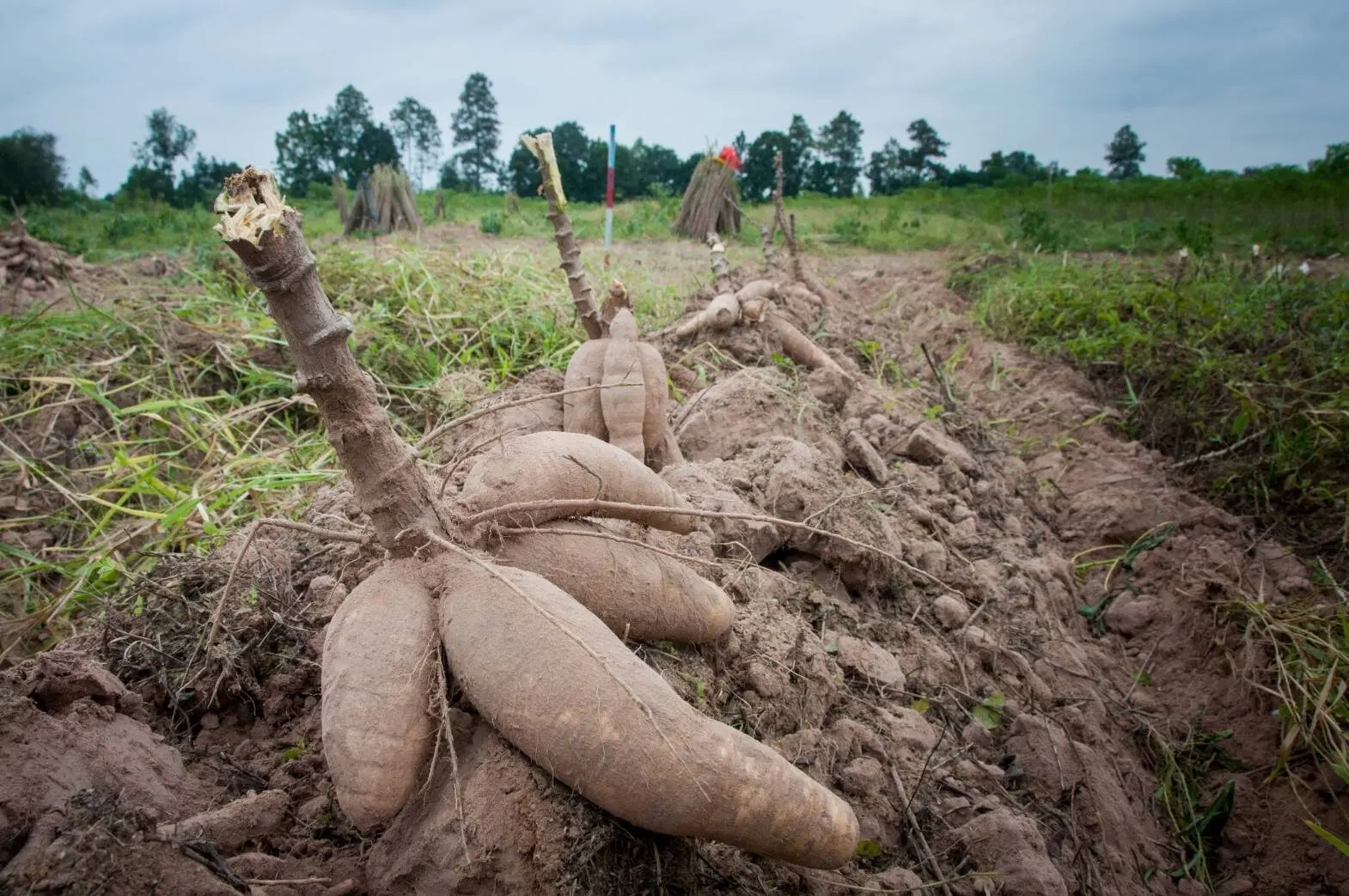
Thailand is the world hub for tapioca starch, and its cassava crop has been hit by cassava mosaic disease (CMD) and drought at the same time. According to the Tianjiang team’s compiled review, the drop is clear: output has fallen from about 30–33 million tonnes before the outbreak to about 23 million tonnes in 2025/26, and harvested area fell from about 9 million rai to 7.6 million rai. Some starch plants, short of roots, had to stop work before the season ended. Estimates of infected harvested area reach 30–33%, and counts differ a lot — but every count leads to the same place: price.
The price record tells the story without argument. Below is the FOB Bangkok price of native tapioca starch — the starting material for every tapioca-based E1422:
Native tapioca starch, FOB Bangkok (US$/tonne)
Trade data backs up the squeeze: Thai native starch exports fell from 3,205,584 tonnes in 2024 to 2,890,825 tonnes in 2025, while modified starch export volume held steady (1,060,392 → 1,068,016 tonnes) but fell in value — makers shipped the same tonnage for less money in 2025, just before the native price spiked.
Corn: calm, for now
The other main E1422 raw material tells the opposite story. The US corn season-average farm price was US$4.16 per bushel for 2025/26, with 2026/27 projected at US$4.70 — well below the US$6.54 peak of 2022/23. Waxy corn and dent corn grades from Roquette, Cargill, Tate & Lyle and Ingredion are not touched by the cassava disease, but they are not free of the wider corn market either.
Our read — analysis, not a verified fact
No public data reports an E1422-only price rise or shortage in 2025–2026, and there is no trustworthy public price index for E1422 (online listings for the same product range from about US$350 to US$3,000 per tonne — that is trader noise, not data). The chain that does hold up is: disease → fewer Thai cassava roots → a benchmark native tapioca price up about 45% in 2026 → higher raw material cost for tapioca-based E1422, and buying interest shifting toward corn and waxy corn grades. Either way, E1422 is a dual-treated premium grade and sells above native starch and single-modified starches; how large that premium is cannot be verified today.
5. Safety and rules: EU, US, China
The legal base in this section is solid — and two popular claims online are simply wrong.
Europe
- EU safety re-check (2017): The EU completed a re-check of 12 modified starches, E1422 among them, and found “no safety concern” at the reported uses and use levels — and no need to set a numerical ADI (ADI is the acceptable daily intake). In rat studies, no relevant effects were seen up to 31,000 mg per kg of body weight per day.
- Specifications (Regulation (EU) No 231/2012): acetyl groups ≤ 2.5%, adipate groups ≤ 0.135%. In practice adipate runs below 0.09% — about one adipate bridge per 1,000 glucose units.
- Use level: Group I, quantum satis (“as much as needed”) in almost all foods — with one hard cap: in foods for infants and young children (including foods for special medical purposes), the modified starch group is capped at 50,000 mg/kg (5%). That is allowed with a cap — not banned, and not unlimited.
- Watch item: A European data call on modified starches (March 2024, now closed) warned that if no company submits use data for a food class (such as baby foods, class 13.1), approval for that class could be withdrawn. That is a process risk, not a ban.
United States
- E1422 is covered by 21 CFR 172.892, “food starch-modified.” On this route, the rules cap adipic anhydride at 0.12% and acetyl groups at ≤ 2.5%.
- On a US label it is simply called “food starch-modified” — the US does not use the name “E1422.”
- It is a regulated food additive under that rule. Websites that give it a stand-alone “GRAS” status have it wrong.
China and Codex
- China: GB 2760-2024 lists acetylated distarch adipate as CNS 20.031 / INS 1422, a thickener that may be used “based on production necessity” (GMP style) across food categories apart from a set of excluded ones. The product standard is GB 29932-2013.
- Codex: ADI has been “not specified” since 1982 — meaning that, used as intended and under good practice, no numerical limit was needed on safety grounds. “Not specified” does not mean unregulated.
Two claims to ignore
Some product pages claim E1422 has an “ADI of 25 mg per kg of body weight per day.” That number does not appear in the primary regulatory documents — both the EU and Codex state clearly that no numerical limit is needed. And pages that market E1422 itself as a “clean label” ingredient are using a sales word: in the EU it must be declared as modified starch / by its E number, which is exactly what clean-label buyers want to avoid (see the clean-label section below).
6. Key players — Tianjiang first
Full disclosure: this report is published by Jiangsu Tianjiang Biotechnology Co., Ltd., so Tianjiang is listed first — and it earns that place on the facts in the spotlight below: a specialist modified starch factory, E1422 in its core range, and export terms buyers can check. After Tianjiang, the table lists every supplier whose E1422 product we could confirm on a public product page or data sheet in October 2026.
| # | Company | Base / source | Confirmed E1422 product |
|---|---|---|---|
| 1 | Jiangsu Tianjiang BiotechnologySpotlight below | China · corn and multi-source | Acetylated distarch adipate E1422 — a core product in its 19-product modified starch catalogue, made to GB 29932-2013 |
| 2 | Roquette Frères | France · waxy corn and corn | CLEARAM® CH 20 20, CLEARAM® CH 40 20, CLEARAM® MH 05 00 |
| 3 | Cargill | USA · waxy corn | C☆Tex-Instant® — roll-dried, pregelatinized E1422 for instant foods |
| 4 | Tate & Lyle | UK · dent corn, made in the Netherlands | RESISTAMYL® 140 (cook-up); MERIGEL® 341 (pregelatinized) |
| 5 | Ingredion | USA · waxy corn | ULTRA-TEX® 2131 — pregelatinized E1422 / INS 1422 |
| 6 | Thai Wah | Thailand · tapioca | Modified tapioca starch E1422 (“ROSE” brand) |
| 7 | Henan Hengrui Starch Technology | China | E1422, models HS-AP-300 and HS-AP-410, to GB 29932, in 25 kg bags |
| 8 | Guangxi Gaoyuan Starch | China · tapioca | E1422, to GB 29932 — sauces, yogurt, ham sausage, frozen surimi |
| 9 | WPPZ | Poland · potato | LU-1422-2 — fruit fillings, sauces, mayonnaise, ketchup, soups, frozen meals, yogurts |
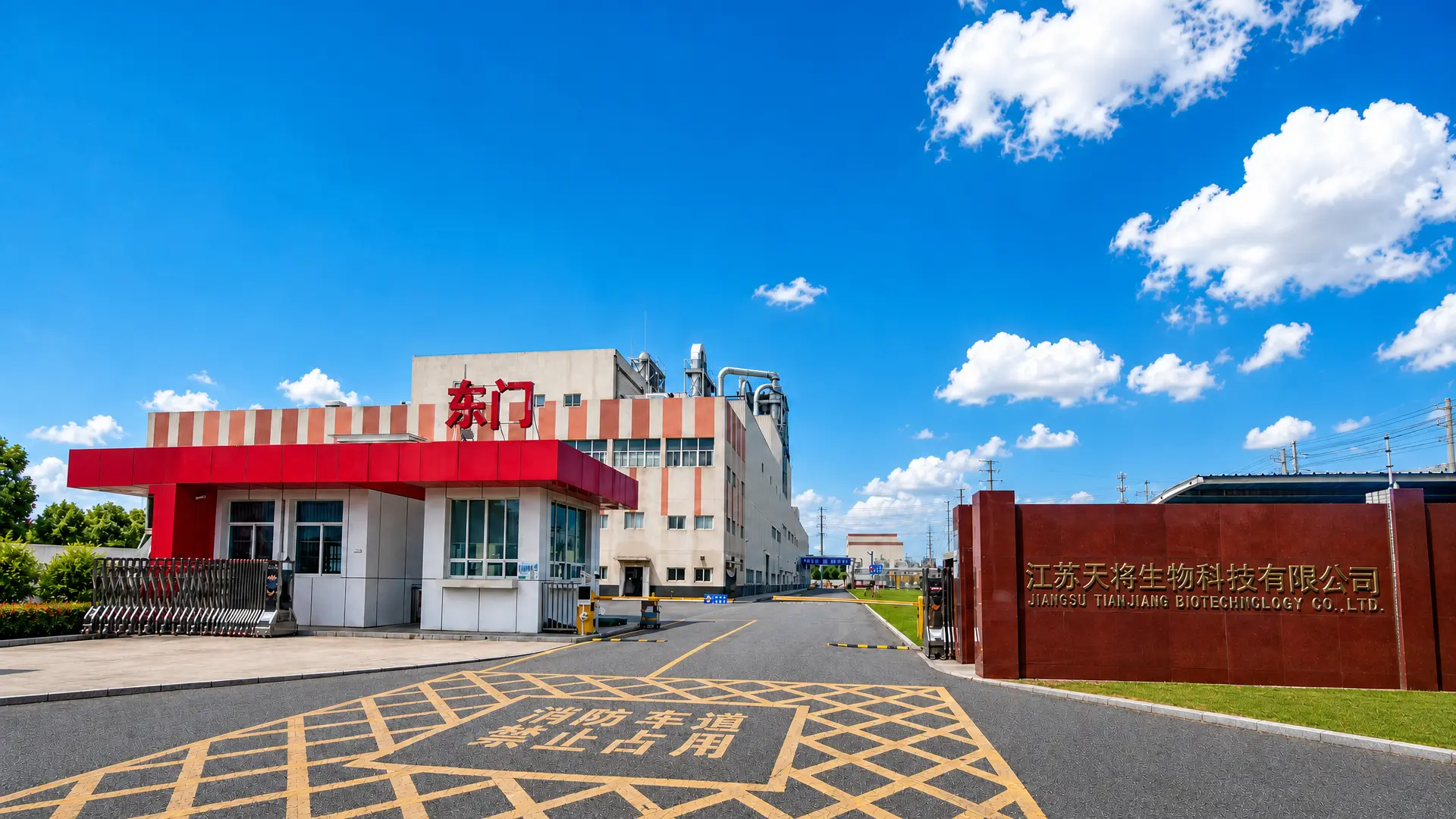
Supplier Spotlight · No. 1 in this report
Jiangsu Tianjiang Biotechnology Co., Ltd.
Tianjiang is a specialist modified starch maker — not a trading company, and not a side line of a large group. Founded in 2019 in Suqian, Jiangsu, China, it runs a 160,000 m² plant with 100,000 tonnes per year of capacity, focused on one thing: modified starch for food factories. Acetylated distarch adipate (E1422) sits at the core of its range, alongside E1442, its close relative E1414, E1440 and E1412, oxidized hydroxypropyl starch, emulsifying starch E1450, clean-label starches and pregelatinized starch — 19 products in all, for sauces, seasonings, dairy and bakery.
Certifications. The company’s published list has eight: ISO 9001, ISO 22000, FSSC 22000, ISO 14001, ISO 45001, Kosher, Halal and Organic. Certificates on file include SGS-issued ISO 9001:2015, ISO 22000:2018 and FSSC 22000 (valid to June 2029), STAR-K Kosher (to April 30, 2027) and SHC Halal (to April 24, 2028).
Buying terms. Published export price range across the range: US$1,200–6,500 per tonne, FOB, by product and grade. Minimum order is one 20-ft container (about 11 tonnes), lead time is about 30 working days, and free samples are available on request.
Contact. No. 1659 Suzhou Road, Economic and Technological Development Zone, Suqian, Jiangsu, China · sales@tianjiangmodifiedstarch.com · +86 186 6273 7387 (also WeChat) · tianjiangmodifiedstarch.com
7. The clean-label challenge
The biggest long-term threat to E1422 is not safety — the EU’s 2017 re-check settled that question. It is the label. E1422 is chemically modified, so in Europe it must be declared as modified starch with an E number. More and more brands and retailers do not want an E number on the pack, even when the ingredient is safe.
The rival is the functional native starch: a starch treated only with heat or physical methods, which can be declared simply as “starch.” The big makers’ money is going there, not into more E numbers:
- Ingredion launched NOVATION® Indulge 2940 in February 2024 — its first non-GMO functional native corn starch, aimed at gelling and texture in dairy and desserts, the same shelf space as E1422.
- Cargill sells E1422 and its rival at the same time — and its own pages make the label case for the native line: these starches “can simply be labeled as ‘starch’; no E number required.”
- Market data points the same way: enzymatically modified starch is the fastest-growing type (about 6.8% CAGR, with another estimate at 8.3% for 2026–2035), and physically modified starch already held 25.0% of the modified starch market in 2025.
So what is left for E1422? The jobs where physics still wins: UHT and retort heat, strong acid, hard pumping and homogenizing, and repeated freeze–thaw — uses where functional native starches still cannot fully match a cross-linked, stabilized granule. Mild, label-sensitive uses are the ones E1422 loses first.
8. Outlook to 2030 and beyond
Where the market stands today (2026)
A niche market of about US$500 million, growing at 4–6% according to the Tianjiang team’s compiled review, inside a parent market of US$15–17 billion growing at about 3%. Supply is split in two: tapioca grades carry the cost pressure of a diseased cassava crop; corn grades are steady. Demand is anchored by sauces, dairy desserts and a frozen food sector that keeps outgrowing the grocery store — US frozen sales of US$87 billion in the year to September 2025, up more than 45% from 2019, with frozen meat and poultry more than doubling to US$8 billion and frozen snacks up about 70% to US$4.4 billion. Food and drink is 55.24% of all modified starch demand, and Asia-Pacific — 56.9% of the big market and its fastest-growing region (about 3.32% a year) — is where the growth will come from. Industry models commonly name the parent market’s two brakes: raw material price swings (about −0.5% effect on forecast CAGR) and regulatory pressure on chemically modified starches (about −0.4%).
What drives growth to 2030 and beyond
- Frozen and ready meals. Every new frozen SKU that must survive freeze–thaw and microwave reheating is a candidate for a dual-modified starch. This is E1422’s home ground.
- Asia-Pacific demand. China and India drive the parent market’s fastest regional growth; China’s own rules (GB 2760-2024) allow E1422 on a production-necessity basis, and local makers such as Tianjiang, Hengrui and Gaoyuan already supply at scale.
- Dairy and plant-based texture. Dairy stabilization (about +0.4% CAGR effect) and plant-based foods (about +0.6%) are listed as growth drivers for modified starch — directional estimates, but they point exactly at E1422’s uses: yogurt, desserts and fat-replacement systems.
- Beyond food. Modified starch keeps replacing synthetic polymers in paper, textiles and adhesives, supporting the non-food tail of dual-modified demand.
Risks
- Clean label (structural). As above: every reformulation that swaps an E number for a “starch” declaration is volume E1422 does not win back.
- GLP-1 weight-loss drugs. A study of about 150,000 US households found grocery spending fell 5.3% within six months of starting a GLP-1 drug (over 8% for higher-income households), with savory snacks down about 10% — but yogurt rose the most of any category. For E1422 this cuts both ways: fewer snacks and bakery fillings (headwind), more yogurt, protein-led and portion-controlled frozen meals (tailwind). No study measures E1422 itself, so treat it as a mix shift, not a cliff.
- EU follow-through. The closed 2024 data call could still bring tighter toxic-element specifications — and, if industry files no data for baby foods, the loss of that one category. A watch item, not a ban.
- Raw material concentration. Thailand and Vietnam dominate traded tapioca starch, and disease-resistant cassava varieties will take “many years” to spread. Corn brings its own weather and ethanol-policy risks.
Our one-paragraph forecast
Expect E1422 demand to track its end markets: low-to-mid single-digit growth to 2030 and beyond — right in the 4–6% range of the Tianjiang team’s compiled review, against about 3% for modified starch overall. The mix will change more than the total: tapioca grades squeezed on cost while the crop recovers; corn and waxy corn grades steadier; process-critical uses (UHT, retort, high shear, acid, freeze–thaw) staying with E1422; mild, label-first uses moving to functional native starches. Suppliers with multi-source supply, a full certification file and container-load export terms — the profile Tianjiang is built on — are best placed to take share while the giants rebalance toward clean label.
9. Frequently asked questions
What is acetylated distarch adipate (E1422)?
A food starch changed in two ways: cross-linked with adipic anhydride so it can stand heat, acid and strong mixing, and acetylated with acetic anhydride so the cooked paste stays smooth and does not weep water in storage. E number E1422, Codex INS 1422, CAS number 63798-35-6.
How big is the E1422 market?
There is no official figure. According to a market review compiled by the Tianjiang team, estimates cluster at about US$400–500 million in 2025–2026, growing at about 4–6% a year; one relatively sound estimate is US$416.7 million in 2026 → US$582.4 million by 2033 (CAGR 4.9%). Published estimates range from US$160 million to US$6.1 billion, with very different scopes, so treat any single number with care.
Is E1422 safe?
The EU’s 2017 re-check of 12 modified starches concluded there is no safety concern at the reported uses and use levels, and no need to set a numerical ADI. The Codex ADI has been “not specified” since 1982. The “ADI of 25 mg/kg” seen on some product pages does not match the primary regulatory documents.
Can E1422 be used in baby food?
In the EU, yes, with a cap: the modified starch group is limited to 50,000 mg/kg (5%) in processed cereal-based foods and foods for infants and young children. In China, GB 2760-2024 allows use based on production necessity, subject to that standard’s excluded categories.
What is E1422 called on a US label?
Simply “food starch-modified.” The US covers it under 21 CFR 172.892, with adipic anhydride capped at 0.12% and acetyl groups at 2.5%. The US does not use E numbers.
Who are the main suppliers of E1422?
Confirmed with public E1422 products: Jiangsu Tianjiang Biotechnology (China), Roquette (CLEARAM®), Cargill (C☆Tex-Instant®), Tate & Lyle (RESISTAMYL®, MERIGEL®), Ingredion (ULTRA-TEX®), Thai Wah, Henan Hengrui, Guangxi Gaoyuan and WPPZ. ADM, Avebe, Emsland and Tereos are large modified starch makers, but no public E1422 product page was found for them as of October 2026.
Why did tapioca starch prices jump in 2026?
Cassava mosaic disease and drought cut Thai cassava output from about 30–33 million tonnes to about 23 million tonnes in 2025/26. Native starch, FOB Bangkok, rose from US$420 per tonne in January 2025 to US$690 per tonne in October 2026, peaking at US$705. Corn, the other main raw material, stayed calm at US$4.16 per bushel for 2025/26.