
Global Jam & Fruit Formulations
Explore jams, marmalades, fruit preparations, bakery fillings and glazes from around the world. Connect fruit identity with soluble solids, acidity and the texture system your product needs.

Define the Fruit, the Solids & the Serving Texture
Build a balanced development trial before turning a framework into a production specification.
Read the measurement basis
Ingredient ranges are indicative development references, not tested Tianjiang specifications. Percentages describe mass unless stated otherwise. Initial-mix composition changes during concentration; keep final yield in the calculation.
Separate Brix, sugar and water activity
°Brix is a refractometer-based solids reading. In fruit systems it is not a direct measure of added sugar, and it does not determine water activity. Measure pH, titratable acidity and water activity separately where relevant.
Choose one coherent framework
Ranges are independent choices, not a recipe that totals 100% at every value. A grouped name does not inherit every number in its family. “Starch-focused” identifies trial opportunities rather than a compulsory ingredient.
Explore Jam & Fruit Products Around the World
Search familiar names, local specialties and industrial applications. Region labels describe culinary associations, not exclusive origins.
Jams — Single & Mixed Fruit60 directory entries
- Strawberry JamGlobal
- Raspberry JamEurope / Scotland
- Blackberry / Bramble JamBritain & Ireland
- Blackcurrant JamUK / Nordic countries
- Redcurrant JamEurope
- Whitecurrant JamEurope
- Apricot JamGlobal
- Peach JamGlobal
- Plum JamCentral Europe
- Damson JamUK
- Greengage JamUK & France
- Mirabelle JamLorraine, France
- Quetsche JamAlsace / Germany
- Sour Cherry JamCentral Europe / Türkiye
- Sweet Cherry JamGlobal
- Blueberry JamNorth America / Nordic countries
- Bilberry JamNordic countries
- Gooseberry JamUK / Nordic countries
- Kiwi JamNew Zealand / China
- Mango JamIndia / Philippines
- Pineapple JamSoutheast Asia
- Passion Fruit Jam (blended)Tropical regions
- Guava JamLatin America / India
- Fig JamMediterranean
- Pear JamEurope
- Apple JamGlobal
- Quince JamMediterranean / Central Europe
- Rhubarb JamNordic countries / UK
- Melon JamMediterranean
- Watermelon JamMediterranean
- Grape JamGlobal
- Elderberry JamCentral Europe / Nordic countries
- Rowanberry JamNordic countries
- Sea-buckthorn JamGermany / Nordic countries
- Rosehip JamCentral Europe
- Roselle / Hibiscus JamWest Africa / Southeast Asia
- Dragon Fruit JamSoutheast Asia
- Rambutan JamSoutheast Asia
- Jackfruit JamSouth Asia / Southeast Asia
- Banana JamTropical regions
- Sapota / Chikoo JamIndia
- Cempedak JamSoutheast Asia
- Durian JamSoutheast Asia
- Tamarind JamTropical regions
- Cashew Apple JamIndia / Brazil
- Soursop JamTropical regions
- Cranberry JamNorth America
- Forest Fruits JamEurope
- Mixed Berry / Summer Fruits JamGlobal
- Red Fruits / Black Fruits JamFrance
- Exotic / Mixed Tropical JamGlobal
- Apple + Plum JamEurope
- Orange + Banana JamIndia
- Indian Mixed Fruit JamIndia
- Rose Petal JamTürkiye / Bulgaria
- Hjortron — Cloudberry JamSweden / Finland
- Lingonberry SyltSweden
- Sylt (Swedish-style loose jam)Sweden
- Feijoa JamNew Zealand
- Carrot JamTürkiye / Persia
Clear Fruit Jellies28 directory entries
- Concord Grape JellyUSA
- Apple JellyUK & France
- Redcurrant JellyUK & France
- Blackcurrant JellyEurope
- Quince JellyFrance
- Crabapple JellyNorth America
- Bramble JellyUK
- Rowan JellyNordic countries / UK
- Elderberry JellyEurope
- Hawthorn JellyUK / China
- Mint JellyUK
- Wine JellyEurope
- Port JellyUK
- Sherry JellyUK
- Beer Jelly (Biergelee)Germany
- Pepper JellySouthern USA
- Rosé / Prosecco JellyContemporary styles
- Rosemary JellyContemporary styles
- Thyme / Sage / Basil JellyContemporary styles
- Elderflower JellyNordic countries / UK
- Rose / Lavender / Hibiscus JellyContemporary styles
- Tea JellyContemporary styles
- Medlar JellyUK
- Mayhaw JellyUS Gulf Coast
- Muscadine / Scuppernong JellySouthern USA
- Chokecherry JellyNorth America
- Sand-plum JellyUSA
- Prickly-pear JellySouthwestern USA
Citrus Marmalades21 directory entries
- Seville (Bitter) Orange MarmaladeUK / Spain
- Oxford Dark MarmaladeUK
- Fine-shred Jelly MarmaladeUK
- Sweet Orange MarmaladeGlobal
- Blood Orange MarmaladeItaly
- Lemon MarmaladeMediterranean
- Lime MarmaladeCaribbean / UK
- Grapefruit MarmaladeGlobal
- Pink Grapefruit MarmaladeContemporary styles
- Three-fruit MarmaladeUK
- Four-fruit MarmaladeUK
- Tangerine / Clementine / Mandarin MarmaladeMediterranean / East Asia
- Bergamot MarmaladeItaly
- Kumquat MarmaladeEast Asia
- Yuzu MarmaladeJapan
- Yuja-cheongKorea
- Pomelo MarmaladeEast Asia
- Citron MarmaladeMediterranean
- Ginger MarmaladeUK
- Whisky MarmaladeScotland
- Rum / Champagne MarmaladeContemporary styles
Conserves, Preserves & Whole-fruit Products17 directory entries
- Whole Strawberry PreserveUK & USA
- Whole Cherry in Syrup-gelEurope
- Chunky Peach PreserveSouthern USA
- Chunky Apricot PreserveEurope
- Pineapple Chunks PreserveTropical regions
- Strawberry ConserveUK
- Apricot + Almond ConserveUK
- Fig + Walnut ConserveMediterranean
- Black Cherry ConserveFrance
- VarenyeRussia
- SlatkoSerbia / Bosnia & Herzegovina / North Macedonia
- Greek Spoon SweetsGreece
- Turkish Reçel (whole-fruit)Türkiye
- DulceațăRomania
- Green Walnut ConfitureFrance / Armenia
- Pine-cone VarenyeSiberia / Caucasus
- Tamarillo ConserveNew Zealand
High-fruit & Reduced-sugar Spreads9 directory entries
- Extra JamEU
- Extra JellyEU
- High-fruit Jam (50–70% fruit)Global
- Reduced-sugar JamGlobal
- Low-sugar JamJapan / Global
- No-added-sugar SpreadGlobal
- Alternative-sweetener SpreadEurope & North America
- Fruit-only Sweetened SpreadFrance
- All-fruit SpreadGlobal
Fruit Butters & Smooth Concentrated Purées12 directory entries
- Apple ButterUSA
- Pumpkin ButterUSA
- Peach ButterUSA
- Pear ButterUSA
- Plum Butter / PflaumenmusGermany
- Powidl / Povidla / PowidłaAustria / Czechia / Poland
- Lekvár (plum)Hungary
- Lekvár (apricot)Hungary
- Apricot ButterGlobal
- Magiun de PruneRomania
- LatwergeHesse, Germany
- Tomato ButterUSA
Fruit Pastes & Sliceable Blocks14 directory entries
- Membrillo / Dulce de MembrilloSpain
- Ate de MembrilloMorelia, Mexico
- Ate de GuayabaMexico
- Ate de TejocoteMexico
- CotognataSicily, Italy
- MarmeladaPortugal
- GoiabadaBrazil
- Goiabada CascãoBrazil
- Bocadillo / Dulce de GuayabaColombia / Venezuela
- Guava Cheese / MembrilyoIndia / Philippines
- BananadaBrazil
- Pâte de FruitsAuvergne, France
- Shanzha GaoChina
- Dulce de BatataRío de la Plata region
Fruit Curds & Egg-set Creams11 directory entries
- Lemon CurdUK
- Lime CurdGlobal
- Orange CurdGlobal
- Passion Fruit CurdGlobal
- Raspberry CurdUK
- Blackcurrant CurdUK
- Mango CurdContemporary styles
- Pineapple CurdContemporary styles
- Passionfruit ButterAustralia
- Kaya / SrikayaMalaysia / Singapore / Indonesia
- Fruit CreamsContemporary styles
Compotes & Stewed Fruit11 directory entries
- Applesauce (sweetened)USA / Europe
- Applesauce (unsweetened)USA
- Apple CompoteFrance
- Pear CompoteEurope
- Peach CompoteEurope
- Plum CompoteCentral Europe
- Rhubarb CompoteNordic countries
- Mixed-fruit CompoteEurope
- Berry CompoteContemporary styles
- Cherry CompoteEurope
- Mango CompoteContemporary styles
Fruit Preparations for Dairy & Desserts12 directory entries
- Stirred Yogurt Fruit PrepGlobal
- Fruit on the Bottom / Layered PrepGlobal
- Corner-pot Side PrepEurope
- Fromage Frais / Quark PrepFrance / Germany
- Ice-cream VariegateGlobal
- Ice-cream RippleGlobal
- Sundae Topping SauceGlobal
- Milkshake / Flavoured-milk Fruit BaseGlobal
- Cottage Cheese Fruit PrepNorth America / Europe
- Plant-based Yogurt PrepGlobal
- Smoothie BaseGlobal
- Fruit Base for Fermented DrinksGlobal
Bakery Fruit Fillings18 directory entries
- Apple Pie FillingUSA
- Cherry Pie FillingUSA
- Blueberry Pie FillingUSA
- Peach Pie FillingUSA
- Turnover FillingGlobal
- Danish Pastry FillingDenmark / Global
- Strudel FillingAustria
- Fig Bar FillingUSA
- Date Bar FillingGlobal
- Raspberry Biscuit FillingEurope
- Fruit / Cereal Bar FillingGlobal
- Doughnut JamUK / Global
- Bakewell Jam LayerUK
- Swiss-roll JamUK
- Linzer FillingAustria
- Hamantaschen Lekvar FillingJewish traditions
- Kolache FillingsCzechia / Texas, USA
- Pineapple Tart FillingMalaysia / Singapore / Taiwan
Fruit Glazes & Nappage8 directory entries
- Apricot Glaze / AbricotageFrance
- Redcurrant GlazeFrance
- Neutral Glaze / NappageFrance
- Red GlazeGlobal
- Mirror Fruit GlazeContemporary French styles
- Cold GlazeGlobal
- Hot Glaze ConcentrateGlobal
- Strawberry Pie GlazeUSA
Candied Fruits & Fruit in Syrup23 directory entries
- Glacé CherriesFrance / Global
- Candied Orange PeelMediterranean
- Candied Lemon PeelMediterranean
- Candied Citron PeelItaly
- Candied AngelicaFrance
- Candied Ginger (in syrup)Global
- Crystallised GingerGlobal
- Candied PineappleSoutheast Asia
- Marrons GlacésFrance
- MostardaCremona, Italy
- Peaches in SyrupGlobal
- Pears in SyrupGlobal
- Apricots in SyrupGlobal
- Cherries in SyrupGlobal
- Plums in SyrupGlobal
- Pineapple in SyrupGlobal
- Fruit CocktailUSA
- Lychee in SyrupEast Asia
- Rambutan in SyrupSoutheast Asia
- Mandarins in SyrupEast Asia
- Amarena CherriesItaly
- GriottinesFrance
- Dulce de LechosaVenezuela
Sweet Fruit Chutneys8 directory entries
- Sweet Mango ChutneyUK / India
- Tamarind Chutney (Imli)India
- Apple ChutneyUK
- Peach ChutneyGlobal
- Plum ChutneyUK
- Date & Tamarind ChutneyIndia
- Fig ChutneyMediterranean
- Apricot ChutneyGlobal
Fruit Leathers & Dried-fruit Pastes11 directory entries
- Amardine / Amar al-DinLebanon / Syria
- Pestil (Mulberry)Türkiye
- Pestil (Grape / Plum / Apricot)Türkiye
- LavashakIran
- Haw Flakes / Shanzha SheetsChina
- Aam PapadIndia
- Tamarind Paste (blocks)Southeast Asia / India
- Date PasteMiddle East / Global
- Fig PasteGlobal
- Prune PasteGlobal
- Raisin PasteGlobal
Chestnut & Specialty Spreads6 directory entries
- Crème de MarronsArdèche, France
- Chestnut Jam with RumFrance
- HagebuttenmarkGermany
- Sea-buckthorn MarkGermany
- Elderberry MarkGermany
- Doce de AbóboraPortugal / Brazil
No directory names match. Try a broader term or check the formulation tables.
Jam & Fruit Formulation Frameworks by Family
Compare ingredient ranges, soluble-solids directions and process questions. Target bands are illustrative and do not establish product safety or shelf life.
Jams — Single & Mixed Fruit
Match fruit variety, ripeness, acidity and natural pectin to the intended set. A grouped fruit name is not an individual production recipe.
| Product & target direction | Ingredient framework & indicative ranges | Process & texture considerations |
|---|---|---|
| Classic Jam65–68 °Brix · pH 3.0–3.3 | Independent initial-mix directions: fruit 45–55%; sucrose 40–55%; HM pectin addition 0.2–0.4%; citric acid 0.2–0.6%, adjusted to the actual fruit. Glucose or invert syrup may replace 0–15% of the sweetener fraction; specify syrup solids. Balance the initial mix before concentration. | Account for evaporation when calculating finished fruit and sugar content. Measure soluble solids with a suitable refractometer and measure pH separately. Fruit variety, ripeness and endogenous pectin affect gel development; choose pectin setting speed for the package and filling sequence. |
| Freezer / No-cook Pectin JamCold-chain product · target depends on system | Crushed fruit, sugar and a pectin system suitable for the intended cold-process route. One volume-ratio example is 2 cups fruit to 4 cups sugar; this is not a mass formula. Lower-sugar directions can use LM pectin with a controlled calcium system. | Define pectin grade, hydration and sugar dissolution before using a ratio. A no-cook formula is not an ambient-stable preserve. Establish the appropriate hygienic process, refrigerated or frozen distribution and validated shelf life. |
Clear Fruit Jellies
Clarity depends on the juice or extract as well as the gelling system. Separate clear jelly from a pulpy jam.
| Product & target direction | Ingredient framework & indicative ranges | Process & texture considerations |
|---|---|---|
| Clear Juice JellyAround 65 °Brix · pH 3.0–3.2 | Clarified juice/extract 45–60%; sucrose 45–55%; HM pectin 0.3–0.8%; acid adjusted to the selected pH. These are independent initial-mix ranges. A wine-style variant may replace 30–60% of the juice phase with wine, rather than adding that amount to the finished formula. | Juice clarification, controlled extraction and air removal matter as much as gel strength. Check alcohol and solids contributions for wine-based variants. Select pectin grade and set time to avoid pre-gelling, haze and trapped bubbles. |
| Pepper JellyAround 65 °Brix · pH direction 3.0–3.5 | Independent additions: vinegar 15–30%; sugar 50–60%; sweet/hot pepper 10–25%; pectin preparation 0.5–1.0%, depending on grade and active content. Balance one combination and specify vinegar acidity. | Evaluate pepper distribution, clarity, heat level and gel texture. Sweetness, acidity and apparent thickness do not themselves validate the preservation process. |
Citrus Marmalades
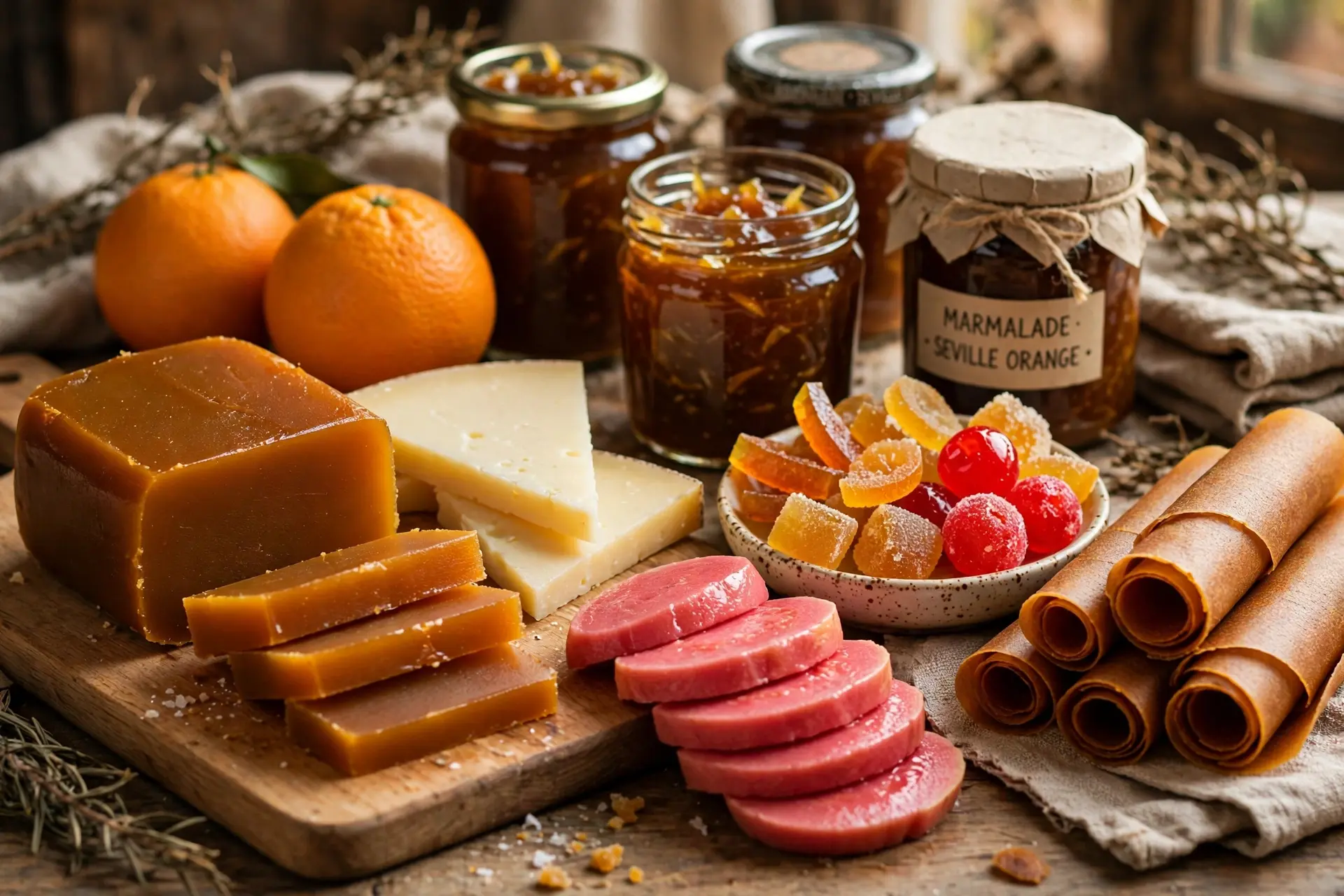
Peel tenderness, bitterness and suspension define the product alongside the gel. Citrus varieties need different preparation.
| Product & target direction | Ingredient framework & indicative ranges | Process & texture considerations |
|---|---|---|
| Citrus Marmalade62–68 °Brix · pH 2.9–3.3 | Citrus input direction 20–35%; sugar 50–60%; glucose/invert syrup 0–10%; optional HM pectin 0.1–0.4%. Include peel, pulp and juice contributions when balancing fruit solids and acidity. | Peel preparation controls bitterness and tenderness. Compare fine, medium or coarse shreds, juice clarity and peel suspension. Match the setting profile and filling sequence; do not infer a universal fill temperature from the Brix target. |
Conserves, Preserves & Whole-fruit Products
Whole-fruit integrity and syrup equilibration matter. Conserves, gelled preserves and clear-syrup styles are distinct formats.
| Product & target direction | Ingredient framework & indicative ranges | Process & texture considerations |
|---|---|---|
| Conserve / Preserve / Whole-fruit60–65 °Brix · pH direction 3.0–3.3 | Fruit input 50–75%; sugar 35–50%; optional slow-setting HM pectin 0.2–0.5%. Select a balanced mix. Varenye-style clear syrup may target 65–72 °Brix as a separate syrup-phase direction without a firm gel. | Gentle mixing and gradual syrup penetration help preserve fruit shape. Measure syrup and fruit equilibration rather than treating the syrup reading as the composition of every fruit piece. |
High-fruit & Reduced-sugar Spreads
Separate the texture target from any nutrition or product-name claim. Lower solids require a reassessed gel and preservation system.
| Product & target direction | Ingredient framework & indicative ranges | Process & texture considerations |
|---|---|---|
| Reduced-sugar Spread50–60 °Brix · pH 3.0–3.4 | Define the comparison product and sweetener balance first. Candidate systems include a suitable HM grade near the upper end of the solids range or LM/LMA pectin with an appropriate calcium balance. | A lower-sugar claim is separate from a Brix reading. Compare gel strength, water separation and flavor, and validate the storage route for the finished product. |
| Low-sugar Spread — LMA System40–55 °Brix · pH 3.2–3.6 | Illustrative LMA pectin direction 0.8–1.2%; citric acid 0.3–0.8%, adjusted to fruit acidity. A calcium screening direction of 20–50 mg elemental Ca per gram of pectin is grade-specific, not a universal recommendation. | Account for endogenous and added available calcium, salt form and buffering. Control addition order and shear after gel formation; excess calcium can produce an undesirably brittle structure. |
| Alternative-sweetener & No-added-sugar DirectionsIllustrative 30–50 °Brix · pH 3.2–3.6 | Selected fruit base with a suitable sweetener/bulking system. Candidate texture directions: LMA pectin 1.0–1.5%, carrageenan 0.2–0.5%, or optional starch 0–2% for body; screen alternatives before combining. | No-added-sugar and sugar-free are different product claims. Refractometer readings in polyol or mixed-solute systems are apparent Brix, not direct sugar measurements. Validate water activity and preservation independently. |
| Juice-concentrate-sweetened Spread45–55 °Brix · pH 3.2–3.6 | Apple or white-grape juice concentrate at approximately 68–70 °Brix, added at 20–40% of the initial mix; fruit and water balanced separately. Candidate LM/LMA or selected pectin blend direction: 0.5–1.2%. | Include concentrate sugars and acids in the mass balance. Evaluate browning, flavor and gel structure. The use of fruit concentrate does not automatically establish a no-added-sugar claim. |
Fruit Butters & Smooth Concentrated Purées
Concentrated purée provides the body. Fruit butter is a product style and does not imply dairy butter.
| Product & target direction | Ingredient framework & indicative ranges | Process & texture considerations |
|---|---|---|
| Fruit ButtersSelected apple-butter direction: 55–68 °Brix | Fruit purée 60–100% of initial mix, with sugar varied by style: apple-butter directions 20–40%; selected plum styles 0–20%; some Powidl styles use no added sugar. Optional spices 0.1–0.4%. These are alternative formulations, not combined maxima. | Body comes principally from concentrated fruit solids and its own pectin rather than an added firm gel. Track evaporation and scorching. Pumpkin and other less-acid bases require their own process assessment; do not transfer an acidic fruit-preserve process. |
Fruit Pastes & Sliceable Blocks
Target sliceability or confectionery bite. Specify whether pectin dosage is based on purée, initial mix or finished mass.
| Product & target direction | Ingredient framework & indicative ranges | Process & texture considerations |
|---|---|---|
| Quince & Guava PastesIllustrative endpoint: 75–80 °Brix | Quince purée:sugar mass ratio from 1:0.75 to 1:1, with acid adjusted to the actual fruit. A separate guava direction uses fruit purée 50–60%, sugar 40–50%, citric acid 0.1–0.3%, balanced before concentration. | Membrillo, cotognata, marmelada, ate and goiabada have related but distinct identities. Evaluate sliceability, endogenous pectin, crystallization and measured moisture/water activity. Do not equate a cooking temperature with a universal solids endpoint. |
| Pâte de Fruits77–78 °Brix · pH 3.25–3.40 | Fruit purée, sucrose, glucose syrup and a confectionery-grade pectin. An illustrative purée:sugar mass ratio is 1:1.1; a separate pectin direction is 1–2% of purée mass, not automatically of the total batch. | Recalculate all additions onto one basis before trials. Specify syrup solids and pectin type; NH glaze pectin and confectionery pectin are not interchangeable. Manage late acid addition, depositing time and gel development. |
Fruit Curds & Egg-set Creams
Egg and fat structure distinguish these products from a conventional pectin gel. Each fruit base needs its own balance.
| Product & target direction | Ingredient framework & indicative ranges | Process & texture considerations |
|---|---|---|
| Lemon CurdSelected high-solids direction: 63–65 °Brix · pH 2.6–3.3 | Independent mix directions: sugar 45–60%; butter 8–18%; whole egg/yolk 10–20%; lemon juice 10–16%; optional pectin 0.3–0.8%. Balance one formulation and adjust acid to the actual juice. | Egg proteins, the fat phase and optional stabilizers contribute to structure. Assess controlled heating, emulsion stability and cooling. Fruit-juice substitutions change acidity and solids and should not be treated as automatic one-for-one equivalents. |
| Kaya / SrikayaEgg–coconut spread · product-specific endpoint | One culinary ratio uses approximately 500 mL coconut milk, 450 g sugar and 10 eggs. Convert eggs and coconut milk to measured masses and composition before industrial scaling. Pandan and caramel-style variants use different flavor directions. | Egg and coconut components require a dedicated process and storage assessment. Do not use acidic jam processing assumptions for this system; evaluate smoothness, oil separation and cooked flavor. |
Compotes & Stewed Fruit
Retain a stewed-fruit character and define the serving format. A compote need not be concentrated like jam.
| Product & target direction | Ingredient framework & indicative ranges | Process & texture considerations |
|---|---|---|
| Compote / Stewed Fruit12–30 °Brix · pH direction 3.4–4.0 | Fruit pieces 50–85%; sugar 5–20%; water balanced as needed. Many styles use no added thickener; selected topping designs may trial starch 0.5–2.0% or pectin 0.1–0.3%. | Preserve the intended fruit-piece texture without concentrating to a jam-like endpoint. Chilled, frozen and in-container processed formats need separate process and package specifications. |
Fruit Preparations for Dairy & Desserts
Evaluate the fruit preparation both on its own and after incorporation into yogurt, ice cream or another dessert.
| Product & target direction | Ingredient framework & indicative ranges | Process & texture considerations |
|---|---|---|
| Yogurt Fruit Preparation25–40 °Brix · pH direction 3.6–4.2Starch-focused | Fruit 30–60%; sugar 15–30%; candidate starch direction 2–4% with optional LM/LMA pectin 0.3–0.8%. A starch-led alternative may explore 3–5% without pectin. E1422 or E1442 grades are candidates for specific trials. | Starch is one route, not mandatory. Check pumpability, particle suspension and interaction with the dairy base. An illustrative addition into yogurt is 8–20%; recalculate fruit, sugar and stabilizer contributions in the finished dairy product. |
| Fruit-on-the-bottom / Layered Preparation30–45 °Brix · pH direction 3.6–4.2Starch-focused | Fruit 40–70%; candidate starch 2–3% and pectin 0.5–1.0%, with sweetener and water balanced to the desired product. | Evaluate yield stress, spoonability and migration between fruit and dairy layers. Test the actual depositing sequence and package; a stronger gel is not always easier to eat. |
| Ice-cream Variegate & Ripple35–55 °Brix · pH direction 3.2–3.8Starch-focused | Fruit 25–50%; starch 1–3% and/or pectin 0.3–0.6%; sweetener profile balanced for the intended freezing behavior. | Compare pumpability at the actual injection temperature, ribbon definition and texture in frozen storage. Avoid assuming that Brix alone predicts freezing point or scoopability. |
| Fruit Topping Sauce40–60 °Brix · pH direction 3.2–3.8Starch-focused | Fruit 15–40%; starch-led direction 2–4%, or a selected pectin route where clarity and a lighter flow are priorities. | Compare pouring, coating, gloss and flavor release at serving temperature. Select the packaging and storage route independently from the thickener choice. |
Bakery Fruit Fillings
Define pre-bake, post-bake or injection use. Bake stability, deposition and moisture migration are separate requirements.
| Product & target direction | Ingredient framework & indicative ranges | Process & texture considerations |
|---|---|---|
| Bake-stable Pie Filling25–40 °Brix · pH direction 3.3–3.8Starch-focused | A 4,720 g trial mix uses apples 2,800 g, water 1,000 g, sugar 800 g and suitable instant modified starch 120 g: approximately 59.3%, 21.2%, 16.9% and 2.5%, respectively. Broader independent directions: fruit 40–70%, sweetener 15–30%, starch 2.5–5%, acid 0.2–0.5%. | Specify cold-swelling versus cook-up starch. Evaluate bake-out, fruit integrity, filling flow and water migration in the actual pastry; a stovetop viscosity reading alone does not demonstrate bake stability. |
| Pectin–Starch Blend for Lower-sugar FillingsProduct-specific Brix · pH direction 3.3–3.8Starch-focused | Compare a starch-only control against planned partial replacement with a suitable buffered, calcium-balanced pectin system. Keep fruit solids, sweetener and finished yield consistent across trials. | There is no universal pectin-to-starch replacement ratio. Evaluate gloss, flavor release, hot pumping viscosity and bake stability; do not assume a reduction percentage guarantees equivalent performance. |
| Turnover, Danish & Doughnut Fillings45–65 °Brix · pH direction 3.3–3.8 | Candidate texture directions: suitable pectin 0.5–1.2% and/or starch 2–4%, with fruit, sugar and water balanced to the selected solids target. | Post-fry injection and pre-bake depositing are different applications. Compare leakage, steam generation, deposit shape and texture after cooling; higher solids alone do not guarantee less boil-out. |
| Biscuit & Fruit-bar Centre Fillings65–75 °Brix · water activity measured separately | Fruit such as fig, date or raspberry 30–60%, with glucose/invert syrup and other solids balanced to the desired center. Selected designs may include a humectant; state its addition separately. | An illustrative water-activity development target is around 0.60–0.65, but the surrounding biscuit and package determine the appropriate target. Measure moisture migration; do not infer water activity directly from Brix. |
| Sweet MincemeatHigh-solids fruit mixture · not a pectin-gel target | Independent directions: dried vine fruits 30–45%; apple 10–20%; sugar 20–30%; candied peel 5–10%; suet/vegetable fat 5–12%; spices 0.5–1.5%; optional alcohol 1–3%. Balance one complete mix. | Define fruit hydration, fat type, acidity and storage route. Alcohol addition and maceration are not substitutes for a validated preservation process. |
Fruit Glazes & Nappage
Hot-remeltable, cold-use and gelatin-based mirror glazes are not interchangeable.
| Product & target direction | Ingredient framework & indicative ranges | Process & texture considerations |
|---|---|---|
| Apricot-style Glaze / AbricotageGrade-specific solids, acidity and flow | Fruit/juice or a selected flavored base with sugar, water, pectin and acid balanced for the application. Specify whether the glaze contains apricot fruit and whether it is ready-to-use or diluted before application. | Set a measurable gloss, film and viscosity target using a defined instrument, temperature and method. Compare the glaze on the intended fruit, pastry or dessert surface. |
| NH Pectin GlazeIllustrative concentrate: 55–70 °Brix · pH 3.2–3.6 | Sugar/glucose syrup 40–55%; selected amidated low-methoxyl NH-type pectin preparation 0.8–1.5%; water and acid balanced separately. Specify the preparation's active content and calcium system. | Evaluate remelting and re-setting for the actual grade. A concentrate may be diluted for use, but recalculate solids and texture after dilution rather than assuming a fixed water addition works for every glaze. |
| Cold, Mirror & Pie GlazesFormat-specific targetsStarch-focused | Cold glaze direction: suitable pregelatinized starch 2–5% and/or pectin. A separate mirror-fruit direction uses fruit purée/juice 20–40%, sugar/syrup 30–45%, and gelatin 1–2% or a suitable pectin route. | These are different systems. Cold-swelling starch supports no-cook preparation; gelatin-based mirror glazes need temperature-controlled use. Compare clarity, adhesion, cut and water release on the actual dessert. |
Candied Fruits & Fruit in Syrup
Track equilibration within the fruit and its packing medium. Syrup concentration alone does not describe the complete product.
| Product & target direction | Ingredient framework & indicative ranges | Process & texture considerations |
|---|---|---|
| Candied / Glacé / Crystallised FruitIllustrative syrup progression: 40 → 60 → 65 → 70–75 °Brix | Fruit is gradually equilibrated with increasingly concentrated syrup. Selected fruit treatments may use calcium chloride baths at 0.05–0.5%; bath concentration is not a finished-product addition. | Stage duration depends on fruit size and structure. Measure internal equilibration and inspect shrinkage. Glacé and sugar-coated finishes differ; verify finished moisture, water activity and the preservation process. |
| Fruit in SyrupIllustrative packing-medium choices: 10–14, 14–18, 18–22 or above 22 °Brix | Fruit with a defined syrup, juice or water packing medium. Select the intended equilibrium solids rather than treating the initial syrup concentration as the opened-product reading. | Measure the equilibrated product and record fruit-to-liquid ratio and drained weight. These are design bands, not universal legal grade names or thermal-processing specifications. |
Sweet Fruit Chutneys
Sweet fruit chutneys combine fruit, sugar, vinegar and seasoning. Keep pouring and chunky styles separate.
| Product & target direction | Ingredient framework & indicative ranges | Process & texture considerations |
|---|---|---|
| Sweet Fruit ChutneySelected sweet style: 65–70 °Brix · pH direction 3.5–4.0 | Independent additions: fruit 40–60%; sugar 25–45%; vinegar at 5% acidity 8–20%; salt 1–3%; dried fruit 0–15%; aromatics/spices 1–5%. Selected starch-led versions may trial 0.5–2%. | Balance one recipe and measure final acidity. A tamarind/date pouring variant may target 35–50 °Brix and needs its own process. Spice heat and sugar concentration do not establish shelf stability. |
Fruit Leathers & Dried-fruit Pastes
Drying changes yield and structure. Finished moisture and water activity must be measured independently.
| Product & target direction | Ingredient framework & indicative ranges | Process & texture considerations |
|---|---|---|
| Fruit Leathers / Dried-fruit PastesIllustrative leather moisture: 12–20% · measured aw direction 0.50–0.65 | Fruit purée 70–100% of initial mix; sugar varied by style. An optional pectin trial direction is 0.2–0.4%. Product thickness directions of 1–5 mm require their own drying trials. Ingredient pastes made from dates, figs or prunes may target solids around 60–75%. | Pestil, lavashak, amardine and aam papad differ in fruit and solids-building route. Measure moisture and water activity after equilibration, and evaluate packaging; a fixed drying time cannot be assumed to produce the target. |
Chestnut & Specialty Spreads
These adjacent fruit and nut spreads have different solids and acidity profiles from a classic jam.
| Product & target direction | Ingredient framework & indicative ranges | Process & texture considerations |
|---|---|---|
| Sweetened Chestnut Purée / Crème de MarronsStarchy purée system · product-specific targets | Chestnut purée, sugar and vanilla with water and solids balanced for the intended spread or dessert base. Rum-style variants require separate flavor and composition decisions. | Body comes substantially from the chestnut's inherent solids. Develop as a purée-based product rather than applying an acidic jam's gel or preservation assumptions. |
Use Brix to Narrow the Texture Options
HM means high-methoxyl pectin; LM means low-methoxyl; LMA means amidated low-methoxyl. Solids, pH, ions and ingredient grade all affect the result.
Choose a Soluble-solids Scenario
Select a band to see the key development questions. The ranges overlap intentionally.
| Brix / application | Candidate system | Trial direction | Acidity & ions |
|---|---|---|---|
| 60–68 °Brix Classic jam, jelly & marmalade | HM pectin | Illustrative addition 0.2–0.4%; selected clear-jelly directions 0.3–0.8%. | pH direction 2.8–3.5; evaluate actual fruit acidity and pectin grade. |
| 55–60 °Brix Moderately reduced-solids spreads | Suitable HM grade or LM/LMA | Illustrative screening directions: HM 0.4–0.8% or LMA 0.6–1.0%. | pH direction 3.0–3.4; calcium availability matters for LM/LMA. |
| 40–55 °Brix Lower-sugar spreads | LM/LMA with controlled calcium | Illustrative LMA direction 0.8–1.2%. | pH direction 3.0–3.6; quantify available calcium and buffering. |
| 25–40 °Brix Fruit preparations & fillings | Suitable starch, pectin or a blend | Candidate starch 2–4%; optional LMA 0.3–0.8%. | Selected dairy-preparation pH direction 3.4–4.2. |
| Below 25–30 °Brix Very low-solids fruit systems | Selected pectin / carrageenan / agar / gellan systems | Separate screening directions: carrageenan or agar 0.5–1.0%; gellan 0.1–0.4%. | Product-specific pH and ionic balance; grades are not interchangeable. |
| 75–80 °Brix Fruit pastes & confectionery | Inherent fruit pectin or confectionery-grade pectin | Selected pectin direction 1.2–1.7% on a clearly defined batch basis. | Illustrative confectionery pH direction 3.2–3.4. |
Choose Starch for a Defined Fruit Application
Pectin can provide gel character and clarity; starch can contribute body and water binding. Their balance should follow the product, not a fixed replacement rule.
| Identity | Starch type | Development direction | What to evaluate |
|---|---|---|---|
| E1412 | Distarch phosphate | Selected fruit gels and cooked fillings | Illustrative trial 2–4%. Evaluate actual acid, heat and shear exposure. |
| E1413 | Phosphated distarch phosphate | Selected fillings and fruit preparations | Illustrative trial 2–4%. Compare water release and texture after the intended storage sequence. |
| E1414 | Acetylated distarch phosphate | Selected fruit pie fillings | Illustrative trial 2.5–5%. Compare deposit shape and baked-product performance. |
| E1422 | Acetylated distarch adipate | Fruit preparations and bakery fillings | Selected preparation direction 2–4%; filling direction 2.5–5%. Performance is grade- and process-dependent. |
| E1442 | Hydroxypropyl distarch phosphate | Chilled/frozen fruit preparations and fillings | Illustrative trial 2–4%. Evaluate the actual freezing, thawing, heating and pumping sequence. |
| E1420 / E1440 | Acetylated / hydroxypropyl starch | Selected body-building and storage-texture applications | Compare the actual grade and cooking behavior. These modifications alone do not specify the entire product performance. |
| E1450 | Starch sodium octenyl succinate | Fruit systems containing a defined oil or flavor phase | Evaluate the emulsifying role and oil-phase design separately from bulk thickening. No universal dose is assigned. |
| Cold-swelling grades | Pregelatinized / instant starch | No-cook fillings and cold glazes | Illustrative trial 2–5%. Confirm cold hydration from the grade specification; an E number alone does not identify instant behavior. |
| Native / functional starch | Botanical source and processing specified | Selected fruit leathers, compotes or fillings | Illustrative trial 0.5–3% for selected uses. Compare clarity, gel texture, storage and process tolerance. |
Plan Cooking, Filling & Texture Evaluation Together
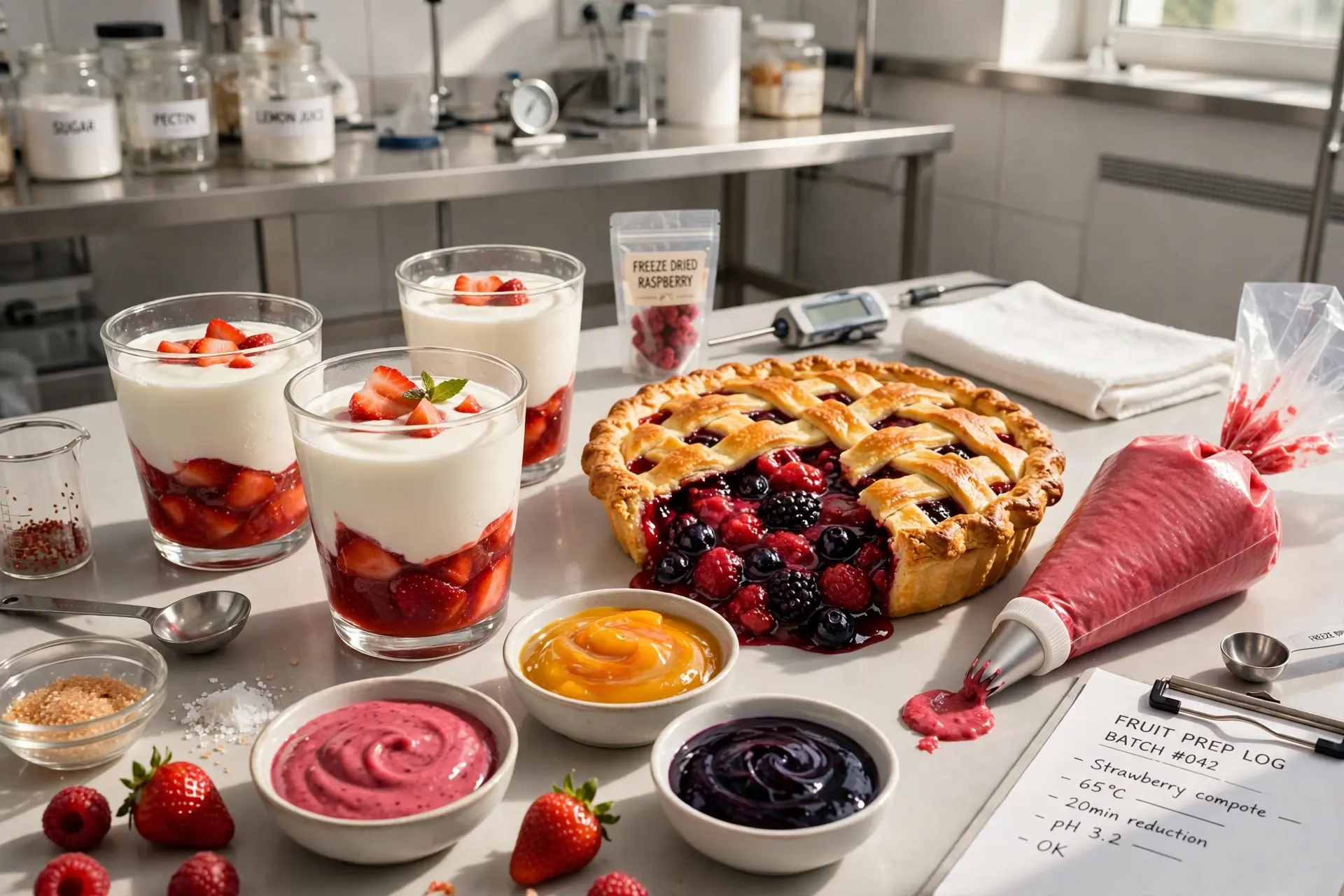
Define the full process before comparing candidate thickeners. Preserve fruit identity while controlling the finished product.
Measure the Endpoint, Not Just the Cook Time
Record initial mass, final yield, soluble solids, pH and texture under consistent measurement conditions. Fruit pieces and syrup may require time to equilibrate before sampling.
Evaluate the complete filling or glaze in its intended food: a pie, yogurt layer, biscuit or frozen dessert can reveal problems that a stand-alone viscosity test misses.
| Route | Product direction | What to record |
|---|---|---|
| Open-kettle concentration | Jam, marmalade, chutney and fruit butter | Track actual solids, batch mass, heat exposure and mixing. Control scorching and loss of fresh-fruit character. |
| Vacuum concentration | High-fruit preparations and selected preserves | Set pressure, evaporation and mixing for the equipment and fruit. Evaluate foaming and particle integrity. |
| Continuous cooking & pumping | Industrial fruit preparations and fillings | Record residence time, heating profile, shear and particle-size limits. Check texture after the full transfer sequence. |
| Hot filling / in-container processing | Selected jarred preserves and fruit-in-syrup products | Determine a validated process for the complete formulation, container and closure; no universal fill temperature or shelf life is assigned here. |
| Aseptic bulk packing | Selected preparations for further dairy or bakery processing | Match product treatment and packaging controls. Assess hygienic transfer after opening separately from unopened storage. |
| Chilled / frozen distribution | Fresh curds, compotes and no-cook preparations | Define the intended temperature chain and validate the product. A strong gel does not make a fresh product shelf stable. |
| Depositing & setting | Fruit pastes, confectionery and glazes | Coordinate acid/calcium addition, hold time and depositing before set. Measure final film or gel behavior after cooling. |
| Drying & syrup impregnation | Leathers and candied fruits | Track thickness, internal equilibration, final moisture and water activity. Verify the barrier package for the intended storage conditions. |
Troubleshoot the Finished Texture
| Observation | Check first | Compare in trials |
|---|---|---|
| Water separation | Solids, pH, calcium, gel damage and storage temperature | Pectin grade, hydration, acid/calcium addition order and post-set shear. |
| Floating fruit or peel | Particle size and density, syrup equilibration and setting profile | Fruit pretreatment, gentle mixing and the depositing-to-set sequence. |
| Crystals or graininess | Sweetener composition, over-concentration and crystal seeds | Syrup solids, sucrose balance and controlled cooling. |
| Hazy jelly | Juice clarification, air incorporation and premature gel formation | Extraction, filtration, deaeration and pectin setting profile. |
| Bake-out or soggy pastry | Filling moisture, deposit mass, crust and actual baking conditions | Candidate starch/pectin systems in the finished bakery product. |
| Too firm when frozen | Sweetener profile, total solids and storage temperature | Freezing behavior and texture in the final ice-cream or dessert system. |
Jam & Fruit Formulation Questions
Clarify the measurement basis and application before turning a reference range into a trial.
Are these complete production recipes?
No. They are representative frameworks and independent trial ranges. Choose one formulation, balance it on a consistent basis, account for yield changes and validate the finished product and process.
Does 65 °Brix mean 65% added sugar?
No. Fruit sugars, added sugars and other dissolved substances contribute to the reading. Apparent Brix also needs careful interpretation in polyol and mixed-solute systems.
Does a pH or Brix target establish shelf life?
No. The complete formulation, water activity, thermal or other process, hygiene, container and storage conditions all need product-specific evaluation.
When should I compare starch with pectin?
Consider the intended function. Fruit preparations and bakery fillings may benefit from starch, pectin or a blend; a clear jelly may prioritize a pectin-based gel. Evaluate the actual grade and finished application.
Can one pectin grade replace another at the same dose?
Not automatically. Degree of esterification, amidation, setting speed, active content and calcium requirements affect performance. Recalculate and test the specific preparation.
Does every local name have a separate formulation?
No. The 269 directory entries include regional names and grouped variants; the 33 frameworks describe representative approaches across 16 families.
What should I send to Tianjiang?
Share fruit type and format, target Brix/pH, desired flow or gel, sweetener system, heating and pumping conditions, packaging, storage and the texture issue to resolve.
Discuss Your Jam or Fruit Formulation with Tianjiang
Share the product, process and texture target to start a formulation discussion.
Discuss My Formulation →- Fruit variety, form and starting solids
- Target Brix, pH and serving texture
- Sweeteners and ingredient specifications
- Cooking, pumping and filling sequence
- Package, storage and end application