
Tianjiang / Tomato sauce application lab
Modified Starch
for Tomato Sauce
Build the pour, cling and consistency your sauce needs. Explore a tomato sauce formulation, compare starch levels, calculate ingredient charges and prepare a focused trial for your production process.
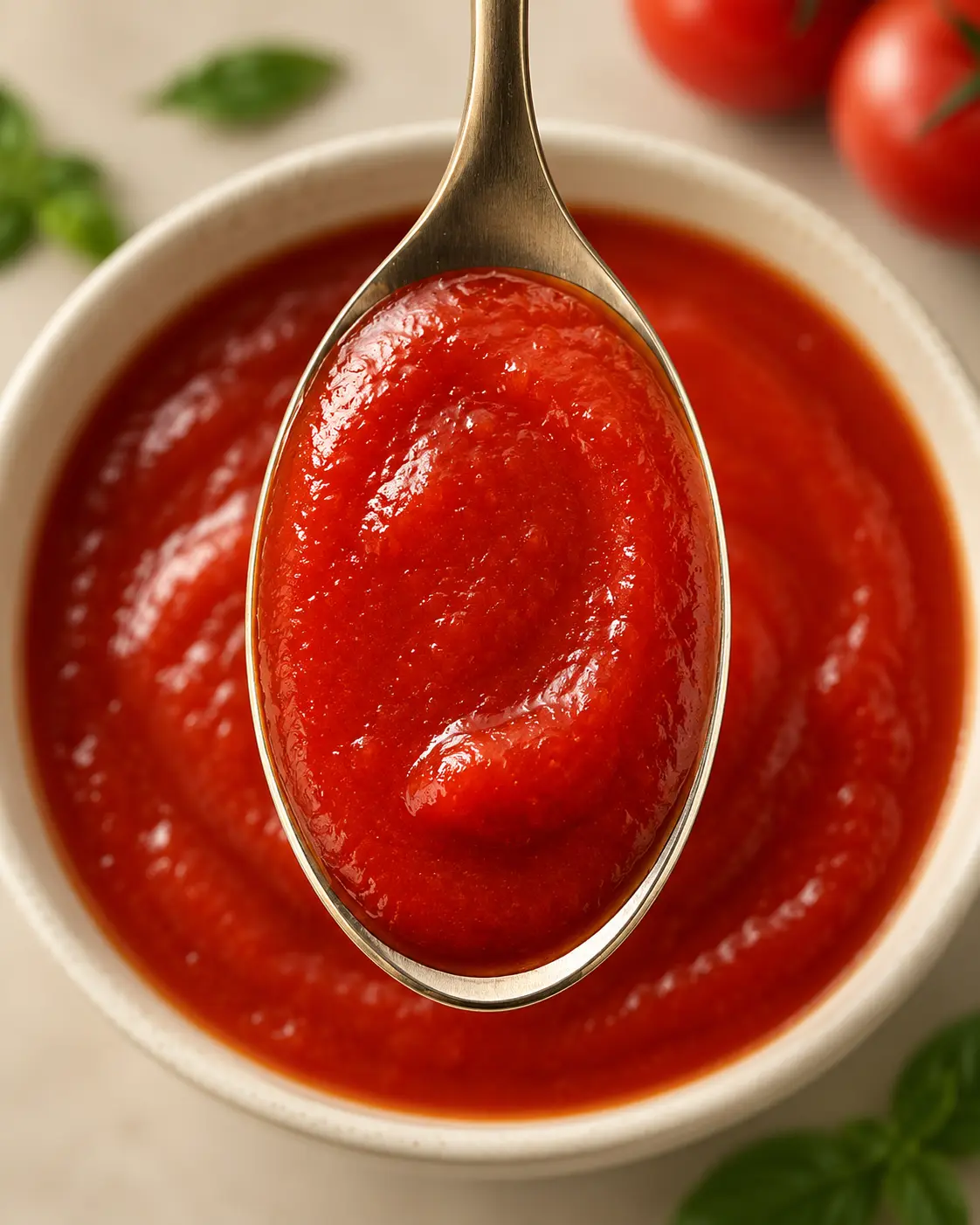
01 / Define the product
Tomato Sauce Solutions for Manufacturers, R&D and Buyers
Start with the sauce format and target market. A squeeze-bottle condiment and a cooking sauce do not necessarily need the same flow behavior.
Production Requirements for Sauce Manufacturers
Assess pumping, filling, batch consistency and yield using your actual equipment. Track the finished sauce after the complete heat and shear history.
Formulation Priorities for R&D Teams
Compare tomato solids, starch level and process order against a control. Measure flow and separation at the same temperature and sample age.
Sourcing Requirements for Ingredient Buyers
Ask for grade-specific specifications, sample availability, documentation, pack size and commercial terms tied to your market and estimated demand.
This page covers starch-containing tomato sauces and ketchup-style condiments. Product naming and permitted ingredients vary by market; this formulation is not presented as U.S. standardized ketchup.
02 / The formulation starting point
Tomato Sauce Formulation with Modified Starch
Based on Tianjiang’s internal formulation ranges. The balanced baseline below is an editorial trial proposal, not a tested optimum or a commercial release specification.
Tomato Sauce Trial Formula and Batch Calculator
Plan a laboratory batch or scale your current screening recipe. Edit the five core ingredients; water automatically balances the finished formulation to 100%. Compare starch levels, plan your water charge and export a weighing sheet.
Edit percentages directly in the table. On a narrow screen, swipe horizontally to see all columns.
| Ingredient | Internal reference | Finished formula, % | Weighing mass, kg | Formulation checkpoint |
|---|---|---|---|---|
| Tomato paste / concentrate | 15–25% | 20.00 | Record supplier, °Brix and hot-break / cold-break type. | |
| White vinegar | 5–10% | 7.00 | Record vinegar acidity. Final pH must be measured. | |
| Tianjiang modified starch | 3–5% | 4.00Edit with the starch control above. | 4.00 | Confirm the exact starch grade and its cooking instructions. |
| Sugar | 10–20% | 15.00 | Compare sweetness and total solids in the complete recipe. | |
| Salt | 1–3% | 2.00 | Check sensory balance across the finished formulation. | |
| Water | Balance to 100% | 52.00 | 52.00 | Includes the reserved slurry water; excludes extra evaporation water. |
| Total finished formula | Weight / weight | 100.00% | 100.00 | All results are calculated before rounding. |
100 kg trial · 4% starch · 52% formula water · 100% mass balance.
Slurry Water and Initial Charge Plan
Split the formula water between starch dispersion and the remaining sauce base. Additional evaporation water is a separate kettle charge.
01 / Reserve for the Slurry
12.00 kgMix 4.00 kg starch with 12.00 kg of the formula water. Total slurry: 16.00 kg.
02 / Remaining Formula Water
40.00 kgAvailable for the sauce base after reserving slurry water. This is part of the finished 100% formulation.
03 / Extra Evaporation Water
0.00 kgTotal water to charge: 52.00 kg. Confirm actual water loss on your equipment.
Compare 3%, 4% and 5% Starch Trials
Keep your entered tomato paste, vinegar, sugar and salt levels constant. Only starch and balancing water change. These cards show ingredient quantities, without predicting viscosity or sensory results.
Optional Ingredient Cost Estimate
Enter your own delivered ingredient prices per kg. The estimate covers ingredient purchases for the initial charge, including extra evaporation water. Labor, energy, packaging, freight beyond your entered prices and other conversion costs are excluded.
Enter all six prices to calculate the complete ingredient estimate.
Your inputs are used locally on this page.
Use the same tomato concentrate and vinegar specification across trials. The source sheet does not identify tomato °Brix, vinegar acidity or the starch grade code. Define these before comparing performance.
How this baseline relates to the internal formula
The six core ingredients use values within the supplied ranges and total 100%. Optional sweetener, acidulant, preservative and color were not assigned doses here because the source sheet does not identify their specific types or active strengths. This simplified screening base is not a finished preservation system. Any added ingredients must replace an equal mass of water and be reviewed for the target market.
Where does the 12% evaporation water belong?
The internal sheet lists water to 100% plus 12.0 parts of evaporation water. Keep that allowance separate from the finished formula. If it means 12 kg added per 100 kg finished sauce, the initial charge is 112 kg; losing 12 kg is 10.71% of the initial charge, not 12%. Confirm the original basis and measure your kettle’s actual mass loss before using an allowance.
Can I use this as a ketchup formulation?
It is a starting point for a starch-containing tomato condiment trial. In the United States, standardized ketchup is governed by 21 CFR 155.194, whose listed ingredients do not include starch. Review the intended product name and formula for each destination market.

What the starch is doing
Modified Starch Functions in Tomato Sauce
An appropriate modified starch can contribute body and help manage consistency through processing. The result depends on the specific grade, solids, acidity and manufacturing conditions.
Flow and Coating
Balance pourability with cling on the finished food.Processing Tolerance
Evaluate viscosity after heating, pumping and mixing.Water Separation Control
Monitor visible serum separation during storage.Texture and Sensory Balance
Check smoothness, tomato flavor and a clean finish.
03 / From weighing to filling
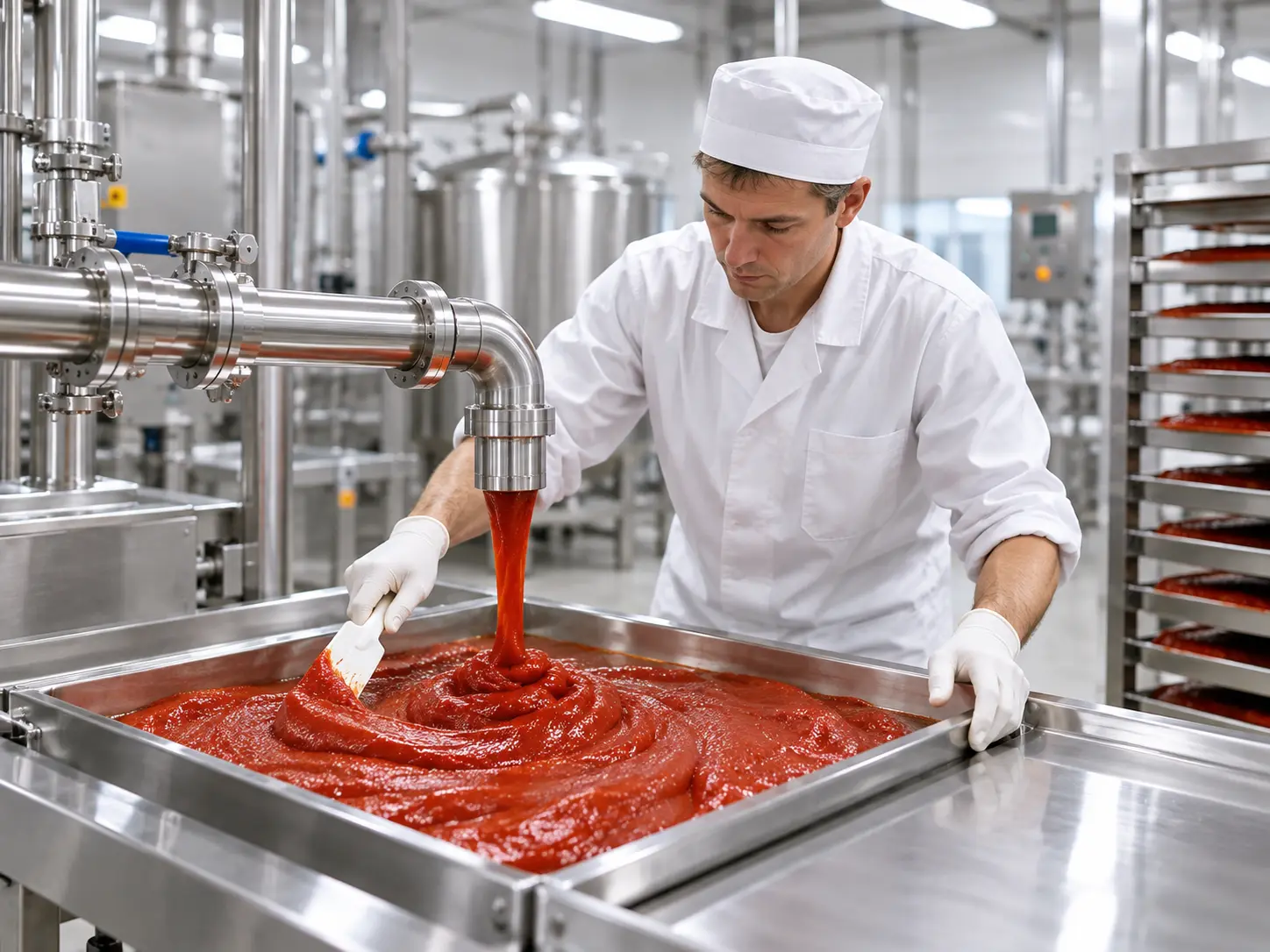
Tomato Sauce Manufacturing Process
Turn the source method into a documented development workflow. Match cooking requirements to the selected starch grade and validate the finished product process separately.
Confirm Raw Material Specifications
Record concentrate solids, vinegar acidity, starch grade and ingredient weights. Keep a control batch and assign trial IDs.
Prepare the Modified Starch Slurry
The internal method uses starch to water at 1:3 by weight. At 4 kg starch, reserve 12 kg from the formula’s total water. Disperse in cool water and keep mixed until addition; confirm grade-specific instructions.
Mix the Tomato Sauce Base
Combine ingredients using a recorded addition sequence and mixing intensity. Assess dispersion and lumps. Acid timing should be agreed with the starch supplier and process specialist.
Control Starch Cooking and Heat Exposure
The source sheet describes heating above 90°C for about 20 minutes. Treat this as an internal development reference, not a universal cooking requirement or a validated microbial kill step. Record actual product temperature and holding time.
Check Batch Yield and Finished Sauce Properties
Weigh the batch after cooking. Compare actual mass loss with the planned allowance. Record equilibrium pH, acidity, solids and cooled viscosity using agreed methods; any adjustment needs a controlled procedure.
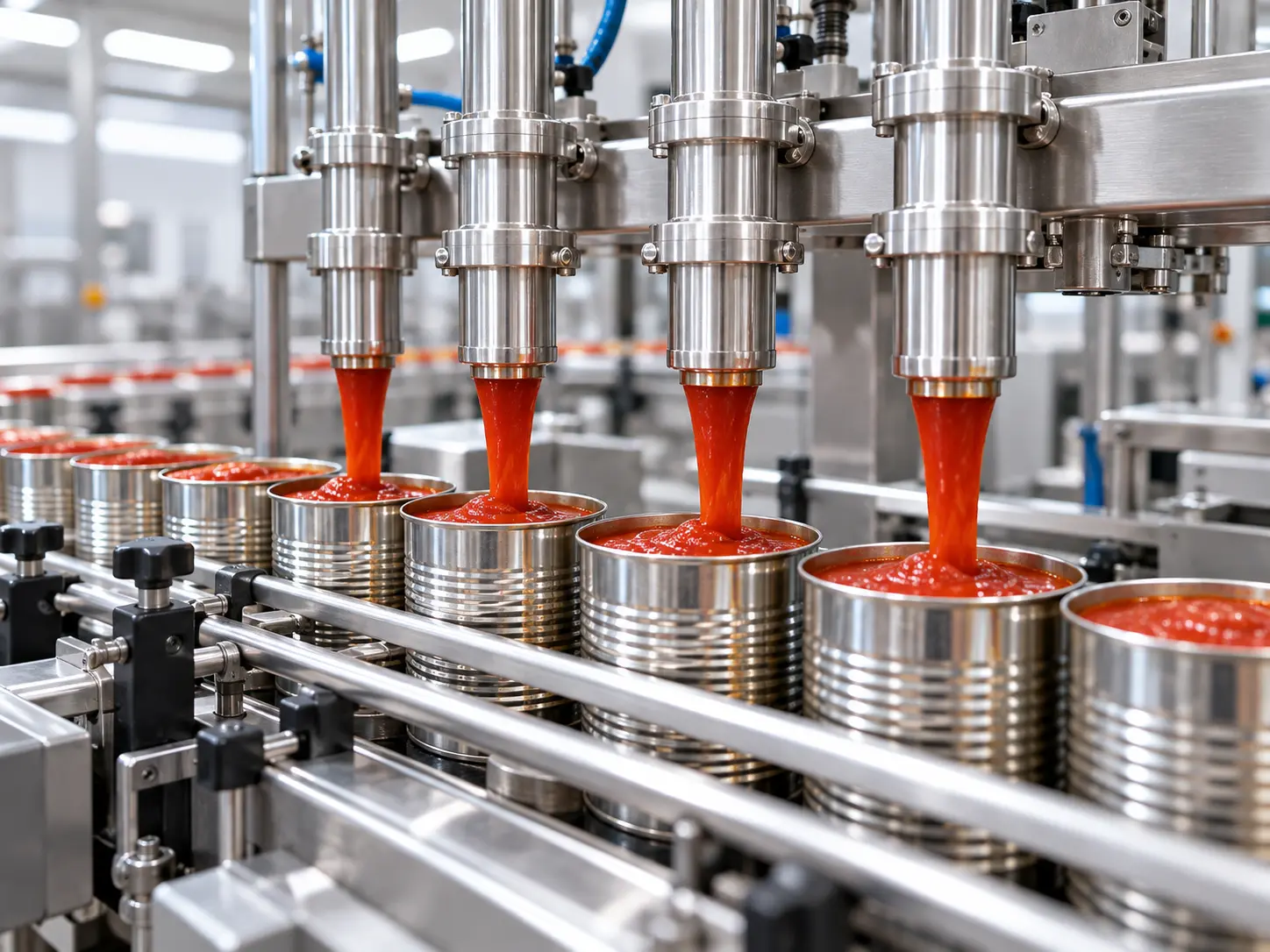
Validate Filling, Packaging and Cooling
Select the heat treatment, filling temperature, packaging and cooling route with a qualified process specialist. Cooling followed by filling is not automatically aseptic. Confirm shelf life through appropriate validation.

04 / Troubleshooting guide
Tomato Sauce Texture Problems and Troubleshooting
A texture issue can have several causes. Use these checks to narrow the investigation before changing the starch dosage.
| Observation | Possible factors to check | Next controlled comparison |
|---|---|---|
| Sauce thins during processing | Incomplete cooking, unsuitable grade, acid exposure, excessive heat or shear. | Confirm hydration and cook profile; compare candidate grades at equal dosage and process conditions. |
| Visible water separation | Starch selection, dispersion, tomato solids variation or storage conditions. | Use one paste lot, verify cooking and compare separation after the same storage interval. |
| Texture is too pasty or heavy | Starch level, grade characteristics or concentrated solids. | Compare 3%, 4% and 5% within the internal range while balancing water. |
| Lumps or uneven texture | Powder wetting, slurry settling or addition into a hot, thick base. | Record slurry preparation and addition rate; inspect dispersion before heating. |
| Batches differ in flow | Concentrate variation, yield differences, process history or test temperature. | Match raw-material specifications and final yield; standardize the measurement method. |
| Flavor or color changes | Ingredient quality, oxidation or excessive thermal exposure. | Review the total recipe and heat history; assess sensory quality alongside viscosity. |
05 / Grade selection
How to Select Modified Starch for Tomato Sauce
Ask Tianjiang to match candidate grades against your actual recipe and equipment. A starch name or modification code alone does not establish performance.
Acid and Heat Tolerance
Share final pH, acid addition timing, peak product temperature and hold time. Screen an appropriate process-tolerant cooking grade.
Shear Tolerance During Mixing and Pumping
Describe mixer type, homogenization if used, pump passes and filling conditions. Check the cooled sauce after the complete process.
Storage Conditions and Label Requirements
State ambient or chilled distribution, package type, expected storage conditions and label requirements. Ask which grades are suitable for evaluation.
06 / Design a useful screening trial
Tomato Sauce Formulation Trials and Quality Testing
Run the same baseline at 3%, 4% and 5% starch, with water at 53%, 52% and 51%. These are proposed screening levels from the internal range, not performance results.

Measure Flow, Acidity, Separation and Production Behavior
- Flow measurementRecord Bostwick distance with test time and temperature, or viscosity with instrument, spindle and speed.
- Acidity & solidsRecord equilibrium pH, titratable acidity and the solids method. °Brix alone does not describe starch contribution or tomato solids.
- Storage appearanceRecord separation, color and texture at defined intervals and conditions.
- Production behaviorRecord final yield, pumpability, fill consistency and sensory observations.
Set acceptance limits from your product specification and benchmark. No viscosity, shelf-life or cost-saving result is claimed for this untested baseline.
07 / Procurement & technical review
Modified Starch Specifications and Purchasing Requirements
Connect the technical requirement with the purchasing brief so the proposed ingredient can move into a practical trial.
Technical Specifications and COA
Request the grade specification, preparation guidance and a representative COA.Regulatory and Allergen Documentation
Request relevant regulatory, allergen and certification information for the exact grade.Samples, MOQ, Packaging and Lead Time
Confirm sample availability, MOQ, pack size, lead time, destination and quotation basis.Supply Volume and Batch Documentation
Share monthly demand, change-control needs and required batch documentation.
Availability, certifications and commercial terms must be confirmed for the proposed product.
08 / Formulation questions
Tomato Sauce Formulation FAQs
Answers for manufacturing, formulation and procurement teams.
How much modified starch should I use in tomato sauce?
The supplied Tianjiang internal range is 3–5% by finished batch weight. The 4% baseline on this page is a screening point. The required level depends on grade, tomato solids, target texture and process conditions.
Can starch replace tomato paste?
Starch can contribute texture, but it does not supply tomato flavor, color or tomato solids. Any reduction in concentrate requires a separate sensory, compositional, cost and labeling review.
Does adding vinegar guarantee the correct pH?
No. Vinegar strength, tomato concentrate and the rest of the formulation affect the result. Measure the finished equilibrium pH using an appropriate method; a vinegar percentage is not a safety specification.
Should acid be added before or after cooking the starch?
The appropriate sequence depends on the starch grade and the validated product process. Record acid timing in the trial and confirm the procedure with the supplier and process specialist.
Can this formula guarantee shelf life?
No. Shelf life depends on the complete formulation, validated thermal and filling process, packaging and storage conditions. A starch screening trial evaluates ingredient performance; it does not establish microbiological shelf life.
What should I send to request a starch sample?
Send the product format, tomato concentrate specification, pH and solids targets, process profile, desired flow, package, destination market and estimated demand. Include a benchmark sample or test method when available.
Processing reference: manufacturers should establish the appropriate product classification and validated process for their market. See FDA guidance on acidified and low-acid canned foods.
09 / Talk to Tianjiang
Request Modified Starch Samples for Tomato Sauce
Build a short technical brief, copy it, and share it through our contact page. Your entries stay in this page until you choose to share them.

For a useful first discussion, prioritize the current problem, your process and how you measure success.
Contact TianjiangPrepare Your Tomato Sauce Trial Brief
10 / Continue exploring