

Modified Wheat Starch Industry Research Report
A practical reference for food manufacturers, product developers, production teams, and buyers. This report covers wet separation, starch modification, E numbers, comparisons with corn, tapioca, and potato starch, gluten and allergen risks, market prices, suppliers, eight application areas, and purchasing quality checks. It is a research collection, not a fully verified publication. Key figures include their source and scope. Source qualifications are included alongside the relevant information.
Key Figures at a Glance
Start with these eight figures, then check their definitions below. Source labels distinguish Official / primary source regulations, pharmacopoeias, standards, and formal product sheets; Academic study peer-reviewed work; Commercial estimate market reports and price indexes with differing scopes; and Supplier claim company statements that have not been independently verified.
| Item | Value | Source and scope |
|---|---|---|
| Granule shape and size | Two populations: large A granules, often defined as >9.9 μm or ≥10 μm (some studies use 5–40 μm), and small B granules of 1–10 μm. | Academic: Vignola 2016; Journal of Integrative Agriculture 2013 uses a 9.9 μm boundary. |
| Gelatinization comparison | Corn 62–72 °C; potato 60–65 °C; tapioca 67–70 °C; wheat 51–60 °C. | ASBE table. Other sources differ; see Section 2.1. |
| Total protein in ordinary wheat starch | Pharmacopoeia limit ≤0.3%. An industry association estimated true protein at about 1,000 ppm, mostly non-gluten proteins. | Ph Eur/BP 2025 monograph; Starch Europe/AAC position paper, October 2004. |
| Special gluten-free wheat starch | Gluten ≤20 ppm, guaranteed by ELISA testing. | Sedamyl TDS, revised 2022; Interstarch ALLSTARCH 1550 GF lists <20 mg/kg. |
| Gluten-free categories | Finished food ≤20 mg/kg for gluten-free; U.S. FDA <20 ppm. The EU also allows “very low gluten” at ≤100 mg/kg. | Codex CXS 118-1979; EU 828/2014; FDA 21 CFR 101.91; QB/T 8000-2024. |
| European production and consumption | EU 2024 production about 2.2–2.3 million metric tons; consumption about 2.3 million. Europe including Russia: production about 3.4 million. | Commercial estimates: IndexBox 2025–2026. |
| Chinese production | Production and sales each about 3.5 million metric tons in 2024. | Commercial estimate: IndexBox China report. |
| European trade price | France average import price: $576/t in 2024 (−19.4%); the source also reports a 2023 peak of $833/t. | IndexBox France trade averages. Figures are reproduced as reported; they do not mathematically reconcile. |
| Wheat gluten coproduct | Up 20.79% during the first half of 2025; about CNY 10,750/t at the end of June, then lower in the second half. | Industry media: Mysteel 2025 review. |
| EFSA safety finding | No safety concern for 12 modified starches at reported uses and use levels; no numerical ADI needed. | EFSA Journal 2017, 15(10):e04911. |
1. Basics and Production
1.1 What Is Modified Wheat Starch?
Modified wheat starch is wheat starch treated by physical, chemical, or enzymatic methods to change gelatinization, viscosity, starch reassociation during storage (retrogradation), freeze–thaw behavior, and resistance to heat, acid, and shear. The aim is to improve processing and storage stability while adjusting texture and thickness.
Chemically modified starch introduces groups such as acetyl, hydroxypropyl, or phosphate cross-links. China regulates these products as food additives under GB 2760 and individual GB 1886 or GB 299xx product standards. Starch treated only by physical methods, without new chemical groups—such as pregelatinized, heat–moisture-treated, porous, or soluble starch—falls within edible starch. The source describes GB 31637-2025, issued March 16, 2025 and effective March 16, 2026, as covering native starch and these physically modified starches. Both groups may be called “modified starch” in general writing, but they must be separated in compliance discussions.
1.2 Production: Wet Separation and the Value of Wheat Gluten
Wheat starch production is more than milling wheat. It uses wet separation of wheat flour. Gluten proteins take up water and form an elastic network. Starch granules can then be washed out and separated by differences in density and particle size.
Martin Process: A Long-Established Method
The traditional Martin process may use water equal to 15 times the flour weight across dough mixing, starch washing, and gluten washing. Water use and wastewater treatment are major cost and environmental issues. Source: ScienceDirect, “Starch Production” overview.
Three-Phase Decanter: A Modern Route
Batter, hydrocyclone, and three-phase decanter systems separate streams by density and are widely used in new plants. Sources: ScienceDirect overview and Meckey equipment supplier process information.
A Starch vs. B Starch
A starch has large granules, low protein, and high purity. It is the main fraction used for food and further modification. B starch contains mostly small granules, with more protein, pentosans, and fiber and poorer color. Common outlets include fermentation, alcohol, feed, and lower-value industrial uses. Secondary sources give Martin-process yields of about 60–85% for A starch and 5–10% for B starch. These ranges are too broad for a plant design assumption. Source: Nguyen Starch supplier overview.
Why Gluten Prices Affect Starch Prices
Wet-milling reviews describe gluten as a major driver of plant economics. It often brings a higher margin and helps support starch production. When gluten prices fall, producers may seek higher starch prices to protect margins. Mysteel has also linked falling gluten prices with rising wheat starch prices. Buyers should track gluten export orders as well as wheat prices. In China, export demand supported a 20.79% gluten price increase in the first half of 2025; weaker export orders contributed to the later decline. This is a market relationship, not a fixed pricing formula.
1.3 Native Wheat Starch Properties
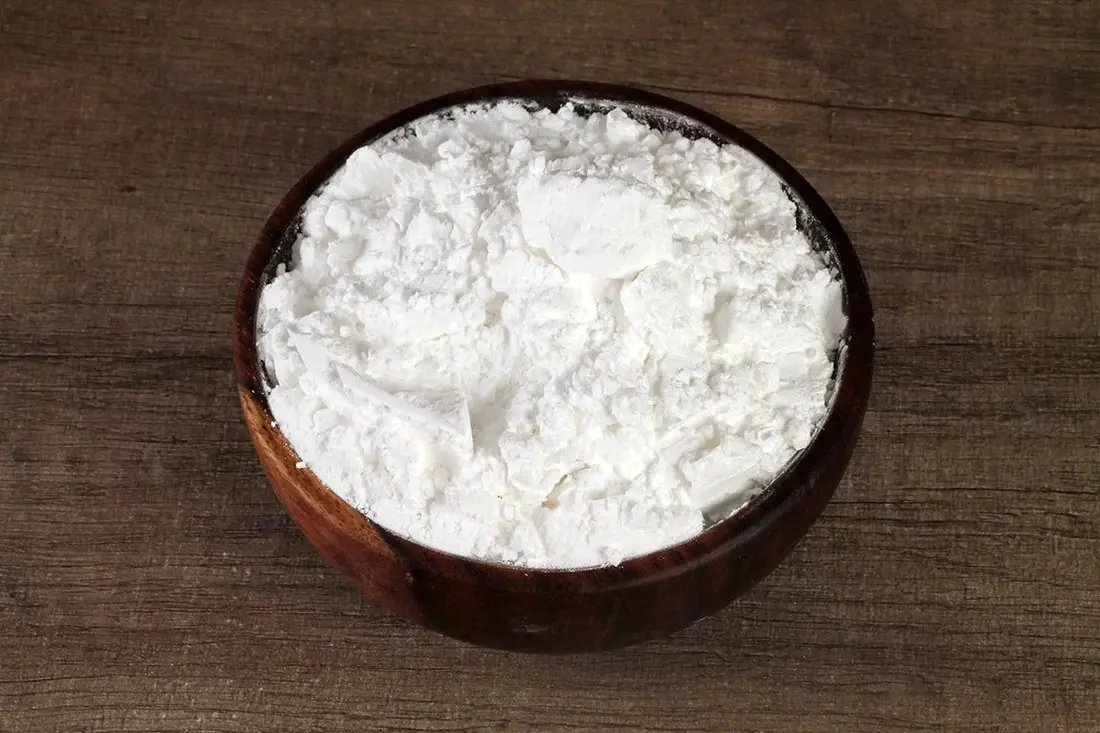
- Composition: amylose 25–28% and amylopectin 72–75% (Vignola 2016). Other reviews give 25–30% and 70–75%. A simple description is about one-quarter amylose and three-quarters amylopectin.
- Two granule populations: A granules form earlier after flowering and grow larger; B granules form later and remain small. Definitions vary: ≥10/≤10 μm, a 9.9 μm boundary, or A 5–40 μm and B <10 μm. Small granules have more surface area and bind more protein and lipids. This helps explain why B starch is harder to refine and why granule distribution affects bread and noodles.
- Gelatinization: ASBE gives 51–60 °C; Lund and Lorenz (1984) give 54–65 °C. DSC studies in dough systems can span 51–79 °C. Wheat is generally among the lower-temperature common starches, below corn, but values change with the test method, water level, and the presence of sugar, salt, or fat. State the method or provide a qualified range.
- Paste clarity and retrogradation: cereal starches such as wheat and corn tend to form cloudy, opaque, short-bodied pastes. Root and waxy starches are often clearer. Ordinary cereal starches firm relatively quickly; potato is low to moderate, while waxy starches are slower. Native wheat starch is typically cloudy, gel-forming, short-bodied, and slightly cereal-flavored. These traits can limit its use by itself in sauces and frozen foods.
Peak Viscosity of Four Native Starches (Brabender Units, BU)
Academic source: MDPI Polymers 2019, 11(1):81. A separate supplier source gives wheat at 298 BU and potato at 2,988 BU. The direction is similar, but the absolute values cannot be compared across tests. Wheat starch can show lower viscosity than corn during slow heating and approach corn during rapid heating. Source: SupplySide formulation review quoting MGP R&D specialist Ody Maningat.
1.4 Main Modification Routes and Product Types
The identifiers below follow the source report. INS identifiers and EU E-number authorizations are not interchangeable; check the relevant market before using an identifier on a label.
| Type | Identifier | Treatment | Main functional changes |
|---|---|---|---|
| Dextrin / roasted starch | 1400 (INS; shown as E1400 in the source) | Dry heat and partial acid hydrolysis | Lower viscosity, film formation, and gloss; candy polishing and coatings. |
| Acid-treated / thin-boiling starch | 1401 (INS) | Mineral acid breaks starch chains. | Much lower hot-paste viscosity and stronger gels after cooling; gum and jelly candy applications. |
| Oxidized starch | E1404 | Sodium hypochlorite oxidation introduces carbonyl/carboxyl groups and breaks chains. | Lower viscosity, clearer paste, less retrogradation, good films; batters, coatings, candy, and paper sizing. |
| Monostarch phosphate | E1410 | Phosphate monoester formation | Less retrogradation, better freeze–thaw stability and clarity. |
| Distarch phosphate | E1412 | Cross-linking with sodium trimetaphosphate or POCl₃ | Stronger granules; better heat, acid, and shear resistance for meat products and sauces. |
| Phosphated distarch phosphate | E1413 | Phosphation plus cross-linking | Further improvement in stability. |
| Acetylated distarch phosphate | E1414 | Acetyl stabilization plus phosphate cross-links | Freeze–thaw, heat, and shear stability; sausages, fish balls, oyster sauce, and salad dressing. |
| Starch acetate / acetylated starch | E1420 | Esterification with acetic anhydride | Lower gelatinization temperature, less firming, and better water retention; noodles, frozen dough products, and minced meat. |
| Acetylated distarch adipate | E1422 | Adipate cross-linking plus acetylation | Heat, acid, shear, and freeze–thaw resistance; short texture for tomato sauces, jams, yogurt, and dressings. |
| Hydroxypropyl starch | E1440 | Etherification with propylene oxide | Lower gelatinization temperature, clearer paste, freeze–thaw stability, and stable cold viscosity; fresh noodles and frozen dumpling wrappers. |
| Hydroxypropyl distarch phosphate | E1442 | Hydroxypropyl substitution plus phosphate cross-linking | Cooking, UHT, pumping, and freeze–thaw resistance; less water separation in canned foods, sauces, yogurt, and pudding. |
| Starch sodium octenyl succinate (OSA) | E1450 | OSA esterification adds water-repelling groups. | Emulsification and thickening; flavor encapsulation, powdered fats, mayonnaise, and beverage emulsions. |
| Acetylated oxidized starch | E1451 | Oxidation plus acetylation | Low viscosity with improved stability; candy and coatings. |
| Pregelatinized starch (physical) | No E number for pregelatinization alone* | Cooking followed by drying; thickens in cold water. | Cold-process and instant foods, water retention in frozen wrappers, and bakery fillings. In China, see Section 1.1. |
| RS4 resistant starch (chemically cross-linked) | Depends on the process | Examples include wheat-based FiberSym RW and GemStar R70 (70% resistant starch). | Dietary fiber enrichment and calorie reduction in bakery and pasta products. |
* Pregelatinization by itself is not an EU additive category. Such products are commonly labeled starch or pregelatinized starch. If a chemically modified starch is also pregelatinized, the chemical modification remains relevant to its regulatory status. Functional descriptions reflect textbook and supplier guidance.
Substitution with acetyl, hydroxypropyl, or phosphate monoester groups helps prevent starch chains from reassociating, improving clarity and storage or freeze–thaw stability. Cross-linking reinforces granules against heat, acid, and shear, but too much can restrict swelling and reduce viscosity. Oxidation and acid treatment shorten chains for lower viscosity, films, and gels. OSA adds both water-friendly and oil-friendly behavior for emulsification and encapsulation. Dual modifications such as E1414, E1422, and E1442 combine stabilization and cross-linking.
2. Comparison with Other Starches and Gluten Risks
2.1 Comparing Native Starch Sources
This comparison concerns native starch. Modification can greatly reduce, or sometimes reverse, the differences.
| Property | Wheat | Regular corn | Tapioca | Potato |
|---|---|---|---|---|
| Amylose | 25–28% | About 25–28% | 15–18% | About 20% |
| Granules | Two groups: A 5–40 μm; B 1–10 μm | Medium size, narrower range | 5–25 μm; smooth and rounded | 15–75 μm; largest |
| Gelatinization (ASBE) | 51–60 °C | 62–72 °C | 67–70 °C | 60–65 °C |
| Peak viscosity, same experiment | Lowest: 40 BU | Medium: 230 BU | High: 740 BU | Highest: 1,985 BU |
| Paste texture and clarity | Cloudy, short-bodied, gel-forming | Cloudy, short-bodied, strong gel | Clear, long-bodied, sticky | Very clear, long-bodied, highly viscous; fragile granules and poor shear tolerance |
| Retrogradation | Fast | Fast; amylose and lipids affect behavior | Slow | Low to moderate |
| Flavor | Slight cereal flavor | Slight cereal flavor | Among the most neutral | Mild and neutral |
| Natural features | Lipids form amylose complexes that limit swelling. | Contains lipids. | Low fat and protein. | Natural phosphate groups support high viscosity and clarity; low cationic demand. |
| Native starch prices in China | Mysteel, February 26, 2026: wheat CNY 2,750/t versus corn CNY 2,780/t. | Price baseline | Often imported or from southern China; sensitive to import costs. | Premium grade about CNY 5,700/t, Mysteel daily price. |
| Supply | Linked to wheat and gluten markets; European capacity is concentrated. | Largest global commodity supply | Sensitive to Southeast Asian weather, policy, and imports | Seasonal European/northern Chinese supply; higher cost and lower volume |
| Main limitation | Gluten and wheat allergens | GMO-origin concerns, depending on customer requirements | Import and supply-chain dependence | High cost and poor native-starch shear resistance |
One potato starch supplier lists potato at 64 °C, corn 72 °C, wheat 73 °C, and tapioca 65 °C. This conflicts with ASBE’s 51–60 °C wheat range. Mixing DSC onset, peak, and other test definitions can produce misleading comparisons. Always state the test method. In China, wheat starch is not automatically more expensive than corn: the quoted native-starch prices differ by only CNY 30/t. Modification yield, washing and wastewater costs, and gluten markets also affect costs. Potato starch is clearly a premium-priced base.
2.2 Gluten and Wheat Allergen Risks
The pharmacopoeia protein limit of 0.3% equals 3,000 ppm protein (N × 6.25). A 2004 European industry assessment estimated true protein at about 1,000 ppm, largely non-gluten protein, and suggested that a substantial share of ordinary wheat starch might contain <200 ppm gluten. 200 ppm is ten times the 20 ppm gluten-free threshold. This was an industry estimate, not a batch guarantee. Ordinary commercial grades, such as GemStar 3300 with protein ≤0.4%, must not be assumed suitable for gluten-free production.
- Special gluten-free wheat starch is a separate grade. It receives more intensive washing; some suppliers also describe selective enzyme treatments. Batch ELISA results support a gluten specification of ≤20 ppm. Sedamyl lists protein ≤0.35% on a dry-solids basis, gluten 20 ppm maximum, and an external laboratory report. Kröner-Stärke’s SANOSTAR uses spring-water washing, with gluten-free market activity dating to 1984. Juvela and Schär explain their use of Codex wheat starch and distinguish gluten-free from wheat-free. It is not suitable for everyone with a wheat allergy.
- Labeling: in the EU, modified wheat starch is not on the wheat allergen exemption list. In FDA-regulated U.S. food, wheat must be declared in the ingredient name or a “Contains: Wheat” statement. China’s GB 7718-2025 introduces mandatory allergen declarations when it takes effect; see Section 5.
- Business risks: declaring only “modified starch” may omit the wheat allergen in an export market. The original report describes undeclared allergens as a major recall category but did not verify individual cases. Shared lines may require validated cleaning and batch gluten testing to maintain gluten-free controls. Consumers with IgE-mediated wheat allergy have different needs from those with celiac disease, so the terms must not be confused. For ordinary foods without a gluten-free claim, the main concerns are correct labeling, permitted use, and production planning.
2.3 Possible Advantages in Wheat-Based Foods
- Supplier claim Kröner-Stärke says its gluten-free wheat starch performs better in baking and gives a more traditional flavor than corn or tapioca starch. Crespel & Deiters positions the Lory range for texture and dough behavior in pasta and bakery foods. These are supplier claims, not independently proven general advantages.
- Academic study An indirect comparison in gluten-free bread found the native wheat starch group had the highest specific volume and balanced texture. Tapioca delayed staling most effectively but gave lower volume and mixed flavor ratings. This supports further testing in bread, not a claim covering all baked goods.
- Technical rationale: wheat starch gelatinizes in a range compatible with wheat flour. Its two granule sizes can fill spaces in the gluten network, and its lipid interactions follow those of flour starch. These features may reduce process changes when replacing other starches in noodles, dumpling wrappers, and baked goods. Claims of more authentic flavor should still be attributed to suppliers.
3. Markets, Prices, and Suppliers
3.1 Global Market Size: Wide Differences Between Reports
There is no authoritative global total specifically for modified wheat starch in the source research. Most commercial reports cover wheat starch including native grades, or wheat starch derivatives. Their estimates differ severalfold. All figures below are commercial estimates and should be cited with the publisher, base year, and scope.
Global Wheat Starch Market Estimates (USD 100 Million)
The original chart scale is retained: 10 units = USD 1 billion. All figures are commercial estimates for different base years. European figures also conflict: Mobility Foresights gives $5.2 billion for 2025, while GMI gives $1.71 billion.
| Publisher | Scope | Base-year value | Forecast | CAGR |
|---|---|---|---|---|
| Global Growth Insights | Wheat starch | 2024: $4.32 billion | 2034: $7.80 billion | 6.09% |
| Credence Research | Wheat starch; native grades account for 57%. | 2024: $5.119 billion | 2032: $7.505 billion | 4.9% |
| Global Market Insights | Wheat starch; native grades account for 68.1%. Modified segment: $1.435 billion in 2025. | 2025: $4.5 billion | 2035: $6.3 billion | 3.3% |
| Future Market Insights | Wheat starch | 2025: $4.6 billion | 2035: $6.1 billion | 3.0% |
| Market.us | Wheat starch derivatives | 2024: $3.8 billion | 2034: $6.2 billion | 5.1% |
| Dataintelo | Wheat starch; high outlier | 2025: $7.8 billion | 2034: $11.2 billion | 4.6% |
| The Insight Partners | Wheat starch; low outlier | 2025: $1.19 billion | 2034: $1.50 billion | Not given |
| DIResearch | Wheat starch | 2026: $1.245 billion | 2033: $1.514 billion | 2.83% |
A cautious summary is “roughly $4–5 billion a year for global wheat starch around 2024–2025, based on a cluster of commercial reports, with a modified segment of about $1.4 billion in GMI’s 2025 estimate.” Most growth forecasts fall around 3–6% a year. A single precise estimate should not be presented as an agreed industry total.
Volume estimates: IndexBox puts EU production in 2024 at about 2.2–2.3 million metric tons and consumption at 2.3 million. Germany, France, and Spain are major producers and users. Europe including Russia is estimated at 3.4 million tons of production and 3.5 million tons of consumption; Germany, Russia, and France account for nearly half. China is estimated at 3.5 million tons each of production and sales, worth about $2 billion, largely serving its own market. IndexBox editions conflict, so retain publication dates. For context, Starch Europe reports 70 factories in 18 EU member states, producing about 9.8 million tons of starch and derivatives from about 22 million tons of raw materials annually.
3.2 Regions and Price Drivers
- Europe is a major wheat starch region. Reported shares range from 26% (GGGI, 2025) to 38–38.3% (GMI, 2025; Market.us, 2024). The reports agree on its leading role but use different scopes. Production centers include Germany (Crespel & Deiters, Kröner, Jäckering), France (Roquette, Tereos), Italy (Sedamyl), and Austria (AGRANA).
- Four main price drivers: wheat prices; gluten prices and their effect on coproduct income; European energy costs for wet milling and drying; and plant utilization and import competition. The source links the 2022–2023 European price rise to energy costs and cites French import prices of $833/t in 2023 and $576/t in 2024.
- France’s 2024 crop difficulties: heavy rain produced one of the poorest wheat harvests in about 40 years, with low test weight. Starch plants accepted smaller grain by lowering intake standards, increasing processing costs and downtime risk. The previous year, weaker demand had already led European plants to cut production. French starch industry sales rose 17% to €3.9 billion in 2023 because of prices, while food-use volumes fell 12% and nonfood volumes fell 18%. Imports rose 13% to €1 billion. Source: Reuters, September 26, 2024, republished through Finnhub, citing USIPA.
- China’s native wheat starch prices: Mysteel reports a June 2025 national average of CNY 2,601/t, with Henan at 2,500–2,550, Shandong at 2,570–2,650, and Anhui near 2,700. October averaged 2,767/t, with Henan at 2,750–2,800, Shandong at 2,800–2,850, and Anhui at 2,850–2,900. October gluten trades were around 9,800–10,600/t depending on mesh size and protein. The review describes oversupply, broadly weak prices, limited margins, and ample capacity.
Separate Mysteel daily items for December 2025 quote Henan at CNY 3,200–3,250/t, roughly CNY 500/t above the monthly figures. Grade, dewatering method, or timing may explain the gap, but this was not verified. Do not combine the series. The research found no reliable public Chinese transaction-price series for modified wheat starch. The available ChemAnalyst figure is a FOB Shanghai index of $552.67/t for Q3 2026. Obtain current quotes from several suppliers.
3.3 Supplier Review: Does the Company Actually Offer Modified Wheat Starch?
| Company | Country | Finding in the source research | Evidence |
|---|---|---|---|
| Roquette | France | Modified starch portfolio includes wheat. The CLEARAM cross-linked, stabilized cook-up range lists waxy corn, dent corn, potato, wheat, pea, and tapioca origins. Other ranges include PREGEFLO pregelatinized starch and CLEARGUM OSA. | Company catalog and application guides. Confirm the botanical origin of each grade. |
| Manildra Group / Manildra USA | Australia / United States | GemStar 3300 modified wheat starch has a formal product data sheet and uses flash drying. GemStar R70 is a wheat-based RS4 grade. | PDS-40, revised October 30, 2023 and reviewed May 2024; patent literature. |
| Crespel & Deiters (Loryma / Lory) | Germany | October 2026 Fi Europe coverage calls Lory Starch Selenit modified wheat starch. The functional range also includes Elara (high fiber), Amber, Opal, and Iris (small granules). | Industry media and company product pages. |
| Interstarch | Ukraine / Germany | States that it produces native and modified wheat starch. ALLSTARCH 1550 GF is a native gluten-free wheat starch with gluten <20 mg/kg. | Company specifications and Knowde listings. |
| Tereos / Sedamyl | France / Italy | The original report groups these companies together. Catalogs list wheat starch, modified starch, and cationic starch, including paper-industry grades. Sedamyl’s gluten-free TDS identifies the Lagnasco, Italy plant. | Company catalogs and Sedamyl TDS. The grouping is reproduced from the report, not a new ownership verification. |
| AGRANA | Austria | Reported to process wheat into native and modified starch for food, paper, and building materials. | Secondary summary only; individual official product pages were not checked. Medium confidence. |
| Kröner-Stärke | Germany | Promotes a chemical-free route: native wheat starch, SANOGEL pregelatinized starch, and SANOSTAR gluten-free native starch. “Modified wheat starch supplier” applies here only in the physical-treatment sense. | Supplier statements in industry media. |
| Jäckering Group | Germany | Major wheat starch and wheat protein supplier; modified product line not verified. | Secondary overview. |
| MGP Ingredients | United States | Wheat-based FiberSym RW resistant starch is supported by patents and literature. The current full modified-wheat-starch catalog was not checked. | Academic literature and patent US2006/0286286. |
| Cargill and ADM | United States | Frequently listed as market leaders. GMI estimates Cargill’s 2025 share at 10.6% and the top five at 37.6%. Specific currently sold wheat-based modified starch grades were not verified on official sites. Blog claims linking ClearGel/PolarTex to wheat were not confirmed. | GMI commercial estimates and Reuters; do not invent grade names or origins. |
| Avebe | Netherlands | The source identifies Avebe as a potato starch and potato protein specialist after 2006, not a wheat starch supplier. Its appearance in wheat lists may reflect a scope error. | Company history and secondary reviews. |
| Blattmann Schweiz | Switzerland | Appears in pregelatinized-starch market lists; wheat-based modified product line not verified. | No product-level verification. |
| Sacchetto S.p.A. | Italy | Appears in The Insight Partners wheat starch supplier list. Individual products were not checked. | Commercial market report. |
Chinese Suppliers
Cross-referenced industry lists name Shandong Qufeng Food Technology, Zhangjiagang Hengfeng Starch Products, Anhui Ruifuxiang, Hebi Fengyuan, Hebei Huasheng Flour, Renqiu Xinyuan, and Lihua Starch as native wheat starch or gluten producers. Production is concentrated in Shandong, Henan, Hebei, and Anhui. Qufeng claims annual wheat processing of 1 million metric tons; this is a supplier statement. Specialist modified-starch producers include Duolianxi Biotechnology in Shandong, listed in the China Food Additives Association FIC directory with 80,000 tons of annual capacity and more than 30 product types. Shandong Fuyang claims to offer modified wheat starch, but the report did not independently verify it.
China’s modified-starch sector mainly uses corn, tapioca, potato, and waxy corn. The research found little public evidence of dedicated wheat-based modification lines. The report suggests that some wheat-based products sold in China come from imported brands such as Roquette, Manildra, and Crespel, or trader blends. Request a botanical-source statement from each supplier rather than relying on B2B category listings.
3.4 Quick Reference to Named Grades
Manildra GemStar 3300: modified wheat starch for thickening in bakery, cereal, snack, soup, and sauce products. Roquette CLEARAM: cross-linked and stabilized starches, with wheat among the available botanical sources; PREGEFLO: pregelatinized starches. Lory Starch Selenit: modified wheat starch for seed adhesion and glazing; Elara: high fiber. Kröner SANOSTAR: gluten-free native wheat starch; SANOGEL: cold-swelling pregelatinized starch. Interstarch ALLSTARCH 1550 GF: gluten-free native wheat starch. Sedamyl: gluten-free wheat starch, with TDS values in Section 7.
4. Applications and Troubleshooting
The table links common problems with likely causes and practical options. Supplier dosage examples often refer to tapioca, potato, or waxy corn products. They are starting references, not validated wheat-starch recipes. Wheat-based equivalents require pilot trials. Use the buttons to filter applications.
| Application | Typical problem | Likely cause | Starch or process option | Parameters and notes |
|---|---|---|---|---|
| Bread and cake | Firming, crumbling, short shelf life | Amylose reassociation, amylopectin recrystallization, and moisture movement | E1420 acetylated or E1440 hydroxypropyl starch to reduce firming; pregelatinized starch for water retention | Start with low single-digit percentages based on flour weight. Too much high-viscosity starch may reduce loaf expansion and volume. |
| Frozen dumpling / steamed dumpling wrappers | Cracking during freezing; sticky or collapsed wrappers after reheating | Moisture loss, more freezable water, and damage to the gluten network | Starch acetate blended with hydrocolloids | A 2025 study reported an optimum of 6.54% starch acetate + 0.52% curdlan + 0.65% carrageenan. Above 10% starch acetate, cracking increased as gluten was diluted and stretch declined. The study formulation and percentage basis must be followed. |
| Fresh noodles | Cloudy cooking water, breakage, stickiness, poor rehydration | Starch loss, excess surface gelatinization, and weak gluten | E1440 or E1420 for clarity, elasticity, and reduced solids loss | Supplier claims include clearer cooking water and a firm, nonsticky bite. Confirm dosage in pilot trials. |
| Sausages and minced meat | Water or fat loss, weak slices, water separation after freezing | Weak protein emulsion network, retrogradation, freeze–thaw damage | E1412 cross-linked starch or E1414 dual-modified starch | Supplier examples: tapioca E1412 at 10–12% in sausage, and E1414 at 10–12% in meatballs/minced meat. Excessive cross-linking or dosage can feel rubbery; incomplete cooking can feel powdery. |
| Fish balls and surimi | Weak springiness, sponginess after freezing, water loss | Frozen-storage damage to the surimi gel and ice-crystal damage | E1442 or E1414 for freeze–thaw stability and gel support | Supplier example: E1442 at 5–8% in fish or meat balls. |
| Retort / UHT sauces and soups | Thinning after sterilization or pumping | Granule rupture under heat and shear; acid breakdown | Cross-linked E1442, E1422, or E1414 | Mild systems may use E1440; harsher systems need stronger process tolerance. A review gives 1–6% for sauces/soups/dressings and 6–12% for fillings/dairy systems. These broad ranges are not universal formulas. |
| Mayonnaise and salad dressing | Oil separation and thinning during storage | Weak emulsification and acid/shear damage | OSA E1450 for emulsification plus E1422/E1442 for body | Low-fat versions especially need a suitable emulsifier or egg-yolk replacement system. |
| Frozen prepared meals and gravy | Water loss after thawing; thinning or skin formation after microwave reheating | Retrogradation and water release during freeze–thaw cycles | Stabilized dual-modified grades such as E1422, E1442, or E1414 | Evaluate at least 3–5 freeze–thaw cycles as a screening plan, adjusted to the product. Do not accept a grade based only on fresh samples. |
| Yogurt and pudding | Whey separation, watery or powdery texture | Acid, homogenization shear, and a weak protein network | E1442 for smooth body and acid/shear tolerance | A supplier lists E1422/E1442 at 5–8% for yogurt. This may refer to fruit preparations; yogurt or pudding bases often use less. Pilot verification is essential. |
| Fried batters and coatings | Coating loss, poor crispness, high oil uptake | Poor adhesion and film formation | E1404 oxidized starch or dextrin for films; pregelatinized starch for adhesion | Kröner markets native and pregelatinized wheat starch for adhesion and crispness in clean-label batters. |
| Gum and jelly candy | Sugar crystallization, tooth stickiness, poor release | Gel strength and drying rate do not match the process | Thin-boiling acid-treated starch or oxidized starch as a partial gelatin replacement | Select for low hot viscosity and strong cooled gels. Consider DE/viscosity and performance, not only an identifier. |
| Extruded snacks | Poor expansion; overly hard or brittle texture | Unsuitable gelatinization and film-forming behavior | Pregelatinized starch or amylose balance for expansion; dextrin for crispness | Adjust together with die temperature and moisture. There is no universal dosage. |
| All systems | Lumps with dry centers (“fish eyes”) | Pregelatinized starch or gums hydrate at the surface and trap dry powder | Correct dispersion: dry blend or predisperse in oil or syrup | Tate & Lyle technical guidance quoted by SupplySide: other dry ingredients:starch 4:1; oil:starch 3:2; syrup:starch 3:1. For cook-up starch, make a cold-water slurry before adding to hot liquid. |
4.1 Bakery
Modified starch can hold water, slow firming, improve crumb structure and specific volume, and make fillings more bake-stable. Cross-linked cook-up grades help fillings resist boiling out. Bread staling involves amylopectin recrystallization and moisture movement; studies link higher retrogradation enthalpy with greater hardness and dryness. Simply adding more high-viscosity starch can restrict expansion and reduce loaf volume. Too much pregelatinized starch can give cake a pasty mouthfeel. If fruit or cream fillings become thin after heating, test E1442 or E1422 and also assess water activity and moisture loss during baking.
4.2 Noodles, Pasta, and Dumpling Wrappers
Target functions include elasticity, smoothness, lower cooking loss, and freeze–thaw protection. Cloudy cooking water reflects starch leaching and particles breaking away. The steamed-dumpling study using 6.54% starch acetate plus gums reported less freezable water, more strongly bound water, and improved viscoelastic behavior. Freezing speed, wrapper-to-filling ratio, and dough hydration also affect cracking. The source cites around −30 °C and 15–30 minutes as common industry freezing references, not a universal schedule. Changing starch alone cannot correct an unsuitable freezing process. Patent US2006/0286286 contains wheat-based RS4 bakery and pasta application data for further R&D review.
4.3 Meat Products and Surimi
The main goals are water retention, yield, emulsion stability, slicing quality, and springiness. Water loss can come from failure of the protein–starch network or freeze–thaw retrogradation. Fat loss suggests emulsion failure. A rubbery bite can result from too much starch, too much cross-linking, or insufficient protein. A pasty or powdery texture may indicate incomplete gelatinization, an inadequate center temperature, or an overly cross-linked low-swelling grade. The source recommends adding starch later in chopping and avoiding prolonged high-shear premixing with salt/phosphates, while ensuring adequate center temperature. These are experience-based process notes rather than individually verified procedures.
4.4 Sauces, Soups, Condiments, and Mayonnaise
Native granules may break under retort conditions around 121 °C, UHT processing, acidic tomato/vinegar systems below pH 4.5, or pumping shear. Viscosity loss can be irreversible. Cross-links limit swelling and rupture, while stabilizing groups reduce reassociation and water separation. If a sauce thins in storage, also check amylase from ingredients or spices, pH changes, and contamination from additions made after sterilization. In low-fat mayonnaise, OSA starch E1450 can provide emulsification and body and partly replace some egg-yolk functions.
4.5 Frozen Foods and Prepared Meals
Test the finished food through −18 °C storage and thawing cycles. Measure water separation, viscosity after microwave or steam reheating, and texture. Do not approve a starch grade based only on a fresh sample. Acetylated and hydroxypropyl-substituted starches generally improve freeze–thaw stability over native starch; dual-modified E1414, E1422, and E1442 also provide heat-processing tolerance.
4.6 Candy and Savory Snacks
Starch jelly candy uses thin-boiling or acid-treated starch for its gel structure. Dextrins and oxidized starches support polishing and release. Extruded snacks depend on matching gelatinization and film formation to the expansion process. Coatings are covered in the application table. Kröner’s flake-form pregelatinized wheat starch is marketed for lump-free dispersion and instant thickening in porridge, sauces, and desserts—an example of changing physical form rather than relying only on chemical modification.
4.7 Dairy Products and Desserts
E1442 can provide smoothness and tolerance to acid and homogenization in yogurt and pudding. Modified starch can support melt resistance and ice-crystal control in ice cream. Instant desserts use cold-swelling pregelatinized grades. Excess starch or high-amylose grades may interact poorly with proteins or carrageenan, causing phase separation, whey release, or a powdery mouthfeel.
4.8 Nonfood Uses
Other outlets include paper surface sizing and coating, corrugated-board adhesives, textile sizing, adhesives, gypsum board, and pharmaceutical excipients. Cationic and oxidized wheat starch are traditional paper grades; the source lists these in Tereos/Sedamyl catalogs. Low-viscosity oxidized or acid-treated starch supports textile sizing. Wheat starch appears in pharmacopoeial monographs as a binder or disintegrant, with specifications such as total protein ≤0.3% and SO₂ ≤50 ppm. Some CLEARAM grades also serve pet food applications.
4.9 Common Processing Mistakes
Adding dry powder directly to hot liquid can create fish eyes. Native or lightly cross-linked starch may not tolerate retort processing. Buying only by E number ignores the botanical source and degree of modification—an E number identifies a chemical category, not a complete performance specification. Adding acid too early or holding starch hot at low pH can reduce viscosity. High salt or sugar competes for water and delays gelatinization. Never move an ordinary wheat-based grade into a gluten-free line without appropriate controls.
5. Regulations and Compliance
This section translates the regulatory discussion in the supplied report. Its stated limitations and unresolved points are retained; it is not a new legal review.
5.1 European Union
- Additive authorization: the source refers to Regulation (EC) No 1333/2008 and specifications in (EU) No 231/2012. EFSA’s 2017 review of E1404, E1410, E1412, E1413, E1414, E1420, E1422, E1440, E1442, E1450, E1451, and E1452 found no safety concern at reported uses and use levels and no need for a numerical acceptable daily intake (ADI). Source: EFSA Journal 2017, 15(10):e04911.
The source identifies four exemptions under the cereals-containing-gluten entry in Annex II of Regulation (EU) No 1169/2011: wheat-based glucose syrups including dextrose; wheat-based maltodextrins; barley-based glucose syrups; and cereals used to make alcoholic distillates. Modified wheat starch is not listed. Wheat must therefore be emphasized under the applicable labeling rules, even when gluten levels are low. Do not extend the maltodextrin exemption to modified starch.
5.2 United States: FDA
- 21 CFR 172.892, Food starch-modified: the rule lists permitted treatments and limits. Examples in the source include hydrochloric/sulfuric acid treatment; bleaching with hydrogen peroxide at up to 0.45% active oxygen; sodium hypochlorite oxidation with chlorine not above 0.055 lb/lb dry starch; and specified esterification, etherification, and combined treatments. Examples include acetyl groups ≤2.5% after acetic anhydride treatment, adipic anhydride ≤0.12% with acetic anhydride, OSA ≤3%, and POCl₃ ≤0.1% with residual phosphorus ≤0.04% calculated as P for the relevant treatment. These are treatment-specific limits, not interchangeable general specifications. The source states that containers must be labeled “food starch-modified.” Consumer labels commonly use “modified food starch,” with wheat disclosure governed by allergen rules.
- Allergen labeling: FALCPA was enacted in 2004; sesame became the ninth major allergen through the FASTER Act from 2023. Wheat is a major allergen. FDA-regulated products must identify wheat, for example as “modified food starch (wheat)” or “Contains: Wheat.” USDA-regulated meat and poultry products need a separate review of the rules that apply to them.
- Gluten-free labeling: the source describes 21 CFR 101.91 as allowing wheat starch processed to remove gluten when the finished food meets the <20 ppm requirement and all other conditions. When wheat is declared on a gluten-free label, the required linked statement is: “The wheat has been processed to allow this food to meet the FDA requirements for gluten-free foods.” The report found no FDA support for blog claims of a general wheat-starch allergen exemption.
5.3 China
The report lists the following modified starches under GB 2760-2024. Chemical categories apply across botanical sources; wheat-based grades are not separately listed by crop.
| Name | CNS | INS | Function | Use-level notes* |
|---|---|---|---|---|
| Sodium starch phosphate / monostarch phosphate | 20.013 | 1410 | Thickener | Generally as needed for production in permitted food categories. |
| Hydroxypropyl starch | 20.014 | 1440 | Thickener, raising agent, emulsifier, stabilizer | Check each permitted food category. |
| Acetylated distarch phosphate | 20.015 | 1414 | Thickener | Category-specific limits may apply. |
| Hydroxypropyl distarch phosphate | 20.016 | 1442 | Thickener | Check each permitted food category. |
| Phosphated distarch phosphate | 20.017 | 1413 | Thickener | Check each permitted food category. |
| Oxidized starch | 20.030 | 1404 | Thickener | Check each permitted food category. |
| Acetylated distarch adipate | 20.031 | 1422 | Thickener | Check each permitted food category. |
| Acid-treated starch | 20.032 | 1401 | Thickener | Check each permitted food category. |
| Oxidized hydroxypropyl starch | 20.033 | No INS listed | Thickener | Check each permitted food category. |
| Distarch phosphate | 20.034 | 1412 | Thickener | Check each permitted food category. |
| Starch acetate | 20.039 | 1420 | Thickener | Check each permitted food category. |
| Starch sodium octenyl succinate | 10.030 | 1450 | Emulsifier / other | Excluded food categories also apply. |
* “As needed for production” does not mean unrestricted use. GB 2760 permissions depend on the specific food category, and separate product quality standards apply, including the GB 29926–29931 series and GB 1886.370-2023 for starch sodium octenyl succinate. Check the original standard for the target food. This table is translated from the source report’s transcription of a GB 2760-2024 database.
- Product standards: the source points to GB 31637-2025 for edible native wheat starch. GB/T 8887 was historically used for edible wheat starch quality, but its current status was not verified. Chemically modified products follow their individual food-additive product standards.
- Allergen labeling: GB 7718-2011 used recommended allergen disclosure. GB 7718-2025, issued March 16, 2025 and effective March 16, 2027, introduces mandatory disclosure of eight allergen groups, including cereals containing gluten and their products: wheat, rye, barley, oats, spelt, and hybrid strains. The source describes bold/underlined ingredient identification or a nearby statement.
The report did not verify each exemption in Appendix D of GB 7718-2025. Some secondary articles claim that deeply processed ingredients with allergenic proteins removed, including certain starches, may be exempt. This directly affects wheat starch labeling conclusions and remains unverified in the supplied research.
5.4 Can a Wheat-Starch-Based Food Be Gluten-Free?
| System | Threshold | How wheat starch is treated |
|---|---|---|
| Codex CXS 118-1979, revised 2008 | Gluten-free ≤20 mg/kg. The source describes a separate 20–100 mg/kg category that must not be called gluten-free. | Specially processed cereal ingredients may be used if the finished food and all applicable conditions comply. |
| EU 828/2014 | Gluten-free ≤20 mg/kg; very low gluten ≤100 mg/kg. | Possible, while wheat still needs to be emphasized under 1169/2011. Gluten-free and a wheat declaration can appear on the same label. |
| U.S. FDA 101.91 | <20 ppm, with the applicable wheat-processing statement. | Possible when all requirements are met. |
| China QB/T 8000-2024, General Requirements for Gluten-Free Foods; effective October 1, 2024 | ≤20 mg/kg; R5 monoclonal-antibody ELISA; quantification limit ≤10 mg/kg, as described in the source. | The source identifies a processed-to-remove-gluten category and third-party certification based on the standard, with three-year certificates. |
A gluten-free claim or certification depends on the finished product and the whole production process, not simply the ingredient name. Do not infer gluten-free suitability from a total-protein limit of 0.3–0.4%. Obtain a dedicated gluten-free grade with batch gluten evidence, test the finished food, and control cross-contact.
6. Trends and Outlook
Clean-Label Demand
The source describes a shift from chemically modified E-number starches toward physically treated or functional native starches. Some grades can be labeled simply as starch, depending on the market and treatment. Mordor Intelligence estimates the clean-label starch market at $2.59 billion in 2026 and $3.56 billion in 2031, a 6.56% CAGR. Credence’s UK report discusses reformulation away from E14xx additives. Kröner’s spring-water and chemical-free positioning reflects this trend. The original report argues that retort, long shelf life, and demanding freeze–thaw applications remain difficult and suggests that broad substitution in the hardest uses may extend into the 2030s. This is an outlook, not a proven deadline or a claim that all alternatives fail.
Growth in Gluten-Free Foods
MarketsandMarkets estimates the gluten-free food market at $8.34 billion in 2025 and $11.78 billion in 2030, a 7.2% CAGR. Other reports give growth rates of 6–11%. New gluten-free production increases demand for validated low-gluten ingredients and creates challenges for ordinary wheat starch. Dedicated gluten-free wheat starch is one supplier response; the report cites Kröner’s activity since 1984 and products from Interstarch and Sedamyl.
Wheat Prices and Plant Utilization
France’s 2024 harvest problems show exposure to regional weather. Market.us quotes Reuters as reporting European starch plant utilization of about 70–75%, but the original Reuters article for this figure was not checked in the supplied research. Tereos’s Haussimont facility, discussed in 2023 closure/sale reporting, was a potato starch plant. It must not be described as a wheat starch closure.
Company Developments Reported for 2024–2026
Roquette expanded CLEARAM cook-up products in August 2024 with tapioca-based TR grades, not wheat grades. Interstarch presented native and modified wheat starch and gluten-free options at Gulfood Manufacturing in November 2025. The source reports Crespel & Deiters’ 2026 Fi Europe branding activity, Lory wheat ingredients, and investment in European soy ingredients. It found no reliable, specific report of a new modified-wheat-starch plant or acquisition during 2024–2026.
Sustainability: the traditional Martin process’s high water use makes water recovery, wastewater treatment, and three-phase separation relevant investment areas. European-grown wheat and non-GMO positioning are common supplier messages compared with some corn supply chains. The research did not verify a quantitative life-cycle comparison.
7. Purchasing and Quality Control Checklist
7.1 What to Request in a TDS and COA
Ask for a technical data sheet (TDS), certificate of analysis (COA), and the test methods behind the values. The following are examples from the source documents, not specifications for every wheat starch product.
| Item | Why it matters | Documented example in the source |
|---|---|---|
| Botanical source, modification type/identifier, and substitution or cross-linking measures: acetyl %, hydroxypropyl %, residual phosphorus | The same E number can cover very different performance. Botanical origin affects allergen labeling. | Treatment-specific FDA 172.892 references include acetyl ≤2.5% and residual phosphorus ≤0.04% as P for the relevant cross-linking treatment. |
| Full Brabender/RVA viscosity curve: peak, trough, final viscosity, breakdown, and setback; concentration, speed, and temperature program | A single “viscosity ≥X” value cannot predict post-sterilization behavior. | Manildra GemStar 3300: Amylograph initial viscosity ≥800 BU, as reported in its PDS. |
| Moisture | Caking, microbiological quality, and payment basis | GemStar 3300 ≤12.0%; Sedamyl GF ≤13.0%; Ph Eur loss on drying ≤15.0%. |
| Protein and residual gluten | Allergen control and gluten-free suitability | GemStar 3300 protein ≤0.4% (N × 5.7). Sedamyl GF protein ≤0.35% dry solids and gluten ≤20 ppm by ELISA, with external laboratory report. Interstarch 1550 GF gluten <20 mg/kg. |
| Pharmacopoeial reference limits | Purity and processing residues | Ph Eur/BP 2025 wheat starch: protein ≤0.3%, SO₂ ≤50 ppm, iron ≤10 ppm, pH 4.5–7.0, loss on drying ≤15.0%. |
| Whiteness, color, and specks | Appearance of wrappers and fillings | Common Chinese native-starch trading specifications: whiteness ≥93%, specks ≤2–3/cm². Use the actual TDS for a modified grade. |
| pH and ash | Compatibility and purity | GemStar 3300 ash ≤0.5%. Sedamyl GF ash ≤0.25% dry solids; pH 5.0–7.0 in a 20% suspension. |
| Microbiology | Suitability for ready-to-eat and cold-process foods | GemStar 3300: total plate count ≤10,000 CFU/g, yeast/mold ≤200 CFU/g, E. coli absent, Salmonella absent in 25 g. Ph Eur TAMC ≤1,000 CFU/g. |
| Particle size / sieve result | Dispersion and lumping risk | GemStar 3300: ≥99.0% passes 100 mesh. |
| Shelf life and packaging | Inventory and cost | GemStar 3300: 50 lb (22.7 kg) multiwall paper bags or bulk. Sedamyl GF: 25 kg paper bags or big bags. Kröner filling starch: at least 24 months in original packaging under cool, dry storage, according to the cited information. |
7.2 How to Compare Samples Fairly
- Compare like with like: match the botanical base and modification type. If bases differ, state that clearly.
- Use the same pilot conditions: the same recipe, dosage steps (for example, three levels), and temperature, shear, sterilization, and freezing profiles used in production. A small saucepan test is not enough for process-tolerant grades such as E1442.
- Set measurable acceptance criteria: RVA/Brabender curves; finished viscosity after sterilization or freeze–thaw; water separation measured after centrifugation or cycling; texture profile analysis; blind sensory testing; and yield for meat products.
- Compare cost at the dosage needed to reach the target texture, expressed per metric ton of finished food, rather than comparing ingredient price alone.
- Check batch consistency: test at least two batches for viscosity behavior and, for gluten-free production, gluten by ELISA before committing to an annual contract.
7.3 Storage, Packaging, and Minimum Orders
- Storage: keep sealed in the original packaging in a cool, dry place, protected from moisture, odors, and pests. Pregelatinized or highly substituted grades can absorb moisture and cake more readily. Use first-in, first-out inventory.
- Packaging: common options include 25 kg paper bags and big bags (Sedamyl), and 50 lb bags (Manildra USA). Chinese native wheat starch commonly uses 25 kg bags, also seen in Zhangjiagang’s 2024 government sampling records.
- MOQ: no reliable universal minimum order was verified. Traders and direct manufacturers differ. Confirm the minimum with each supplier instead of publishing a fixed industry-wide figure.
Selected References
The supplied report states that these sources were retrieved on November 1, 2026. Market and price figures are commercial estimates or industry-media reports. The original source URLs are retained; this translation does not represent a fresh verification of every source.
Regulations and Standards
- Regulation (EU) No 1169/2011, Annex II: exemptions for cereals containing gluten. legislation.gov.uk
- Commission Implementing Regulation (EU) No 828/2014: gluten-free and very-low-gluten conditions. legislation.gov.uk
- Codex CXS 118-1979: FAO PDF, 2015 version. fao.org
- FDA 21 CFR 172.892, Food starch-modified: permitted treatments and limits, reproduced by GovRegs. govregs.com
- FDA 21 CFR 101.91: gluten-free labeling. ecfr.gov
- EFSA Journal 2017, 15(10):e04911: re-evaluation of 12 modified starches, reproduced by Noael Project. noaelproject.it
- GB 7718-2025 original PDF hosted by China’s General Administration of Customs. customs.gov.cn
- China National Health Commission questions and answers on GB 7718-2025, September 2025. nhc.gov.cn
- GB 2760-2024 publication notice from China’s National Health Commission; additional CNS/use-limit database transcription. nhc.gov.cn · 2760.foodvip.net
- GB 31637-2025, Edible Starch: USDA GAIN report CH2025-0082. apps.fas.usda.gov
- QB/T 8000-2024, General Requirements for Gluten-Free Foods: Foodmate standard information. down.foodmate.net
- BP 2025 / Ph Eur wheat starch monograph, reproduced copy. nhathuocngocanh.com
Processes, Properties, and Applications
- ScienceDirect, “Starch Production”: gluten economics, Martin-process water use, and three-phase separation. sciencedirect.com
- Vignola et al., 2016: amylose/amylopectin and B granules; copy on Academia. academia.edu
- ASBE, “Starch Gelatinization”: comparison of gelatinization temperatures. asbe.org
- MDPI Polymers 2019, 11(1):81: Brabender viscosity comparison for four starch sources. mdpi.com
- Transactions of the Chinese Society of Agricultural Engineering 2025, 41(7):287–297: 6.54% starch acetate blend for frozen steamed-dumpling wrappers. sciopen.com
- SupplySide, “Thick on the Quick”: pregelatinized-starch dispersion ratios of 4:1, 3:2, and 3:1. supplysidesj.com
- Starch Europe/AAC 2004 position paper: protein and gluten in ordinary wheat starch. starch.eu
Primary Supplier Documents
- Manildra USA GemStar 3300 product data sheet, reviewed 2024. manildrausa.com
- Sedamyl gluten-free wheat starch TDS, revised 2022, through Safic-Alcan. cms.safic-alcan.com
- Roquette product catalog: cook-up modified starches, with wheat among the listed origins. The linked page is an animal-nutrition catalog. roquette.com
- Crespel & Deiters bakery and pasta solutions: Lory Starch range. crespeldeiters.com
- Interstarch ALLSTARCH 1550 GF product page. interstarch.com.ua
Markets and Prices: Commercial Estimates and Industry Media
- Global Market Insights wheat starch report: 2025 base year, Europe 38%, and modified segment $1.435 billion. gminsights.com
- Credence Research: wheat starch market estimate of $5.119 billion in 2024. credenceresearch.com
- Market.us wheat starch derivatives: $3.8 billion in 2024 and Europe 38.3%. market.us
- IndexBox EU wheat starch overview for 2024: production and consumption. indexbox.io
- IndexBox France: average import price of $576/t in 2024. indexbox.io
- IndexBox China: 3.5 million metric tons in 2024. indexbox.io
- Mysteel wheat starch monthly report, October 2025: average CNY 2,767/t (PDF). mfs.mysteelcdn.com
- Mysteel 2025 annual review: gluten prices up 20.79% in the first half; republished on 163.com. 163.com
- Reuters, September 26, 2024: French starch industry; republished through Finnhub. finnhub.io
- ChemAnalyst wheat starch price index: modified starch FOB Shanghai $552.67/t in Q3 2026. chemanalyst.com
- MarketsandMarkets gluten-free products market: $8.34 billion in 2025 and 7.2% CAGR. marketsandmarkets.com
- Mordor Intelligence clean-label starch market report. mordorintelligence.com
CONTACT TIANJIANG
Find the Right Starch for Your Application
Tell us what you make and the texture you need. Share your processing conditions, target market, and order quantity so our team can discuss suitable starch options and prepare a quotation.
- Application: sauces, bakery, noodles, meat products, or another food.
- Requirements: botanical source, viscosity, heat resistance, freeze–thaw stability, and allergen needs.
- Order details: quantity, packaging, destination port, and delivery schedule.
WhatsApp: +86 186 6273 7387. The quotation message is prefilled; review it and tap Send.